Jean-Paul Sartre's OCEAN Profile: The Personality Behind "Existence Precedes Essence"
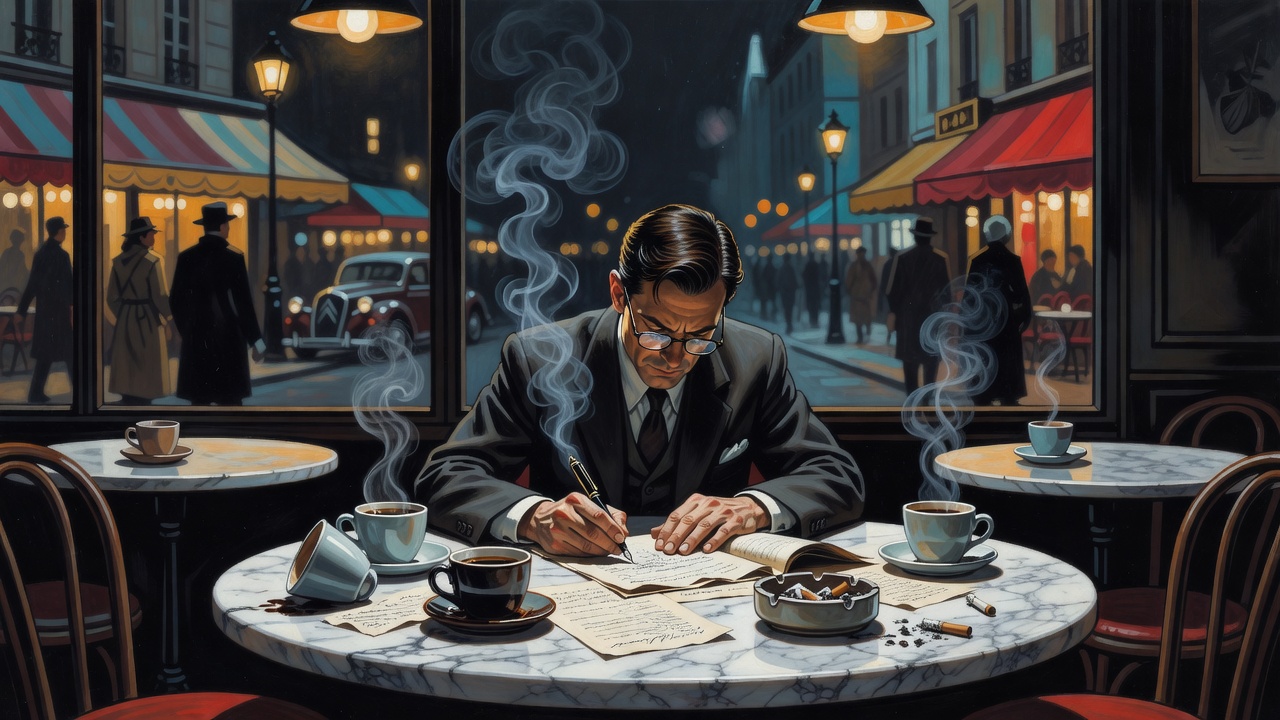
Jean-Paul Sartre built the twentieth century's most influential argument against the idea of a fixed self. Existence precedes essence: no nature was installed in you at the factory, and every appeal to "that's just how I am" is bad faith, a lie told to escape the vertigo of freedom. He made this case in cafés, on a schedule kept for decades, fueled by a documented and unvarying regimen of tobacco and amphetamines with alcohol close behind, while conducting his feuds and his famous open relationship in patterns so consistent that biographers can set their watch by them.
In other words: the man who denied essence is one of the easiest people in intellectual history to score.
The estimated profile
We answered the 120-item assessment from the biographical record and normed it against men of his age band. The complete 30-facet profile is public. Headline numbers: Openness 95, Extraversion 75, Neuroticism 49, Conscientiousness 19, Agreeableness 7.
The engine: an O domain near the ceiling
Liberalism (O6) at 96 is the philosophy in a single number. The facet measures appetite for overturning received ideas, and Sartre spent a whole career overturning them on principle: bourgeois morality first, then academic philosophy. The Nobel Prize got the same treatment when he refused it in 1964, on the grounds that no writer should let himself be turned into an institution. Imagination (O1) at 94 wrote the novels and plays; Intellect (O5) at 91 wrote the 700-page treatises. When a mind like this needs to explain its own restlessness, it goes well past describing a trait and builds a metaphysics in which restlessness is the human condition, and everyone who feels settled is lying to themselves.
The chaos: C at 19, with two spikes
The Conscientiousness facets split in the way that makes domain scores nearly useless. Orderliness (C2) sits at 2 and Dutifulness (C3) at 1: he owned almost nothing, gave money away as fast as it arrived, kept no archive, and broke commitments to publishers and political allies with a clean conscience. Yet Self-Efficacy (C1) lands at 89 and Self-Discipline (C5) at 73, because inside the chaos ran an iron writing schedule that produced one of the largest bodies of work in modern letters. This is the productive-chaos signature: no external structure survives contact with the man, while the one internal commitment, the work, never misses a day. People carrying this shape are routinely misdiagnosed as undisciplined by everyone who confuses tidiness with output, a confusion the facet conflict guide addresses directly.
Immoderation (N5) at 91 is the profile's loudest warning light, and the record backs it without mercy: the corydrane tablets chewed by the tube while writing the Critique, and the two packs a day on top of drinking that alarmed even his circle. A philosophy of total self-authorship lived inside a body being run, in large part, by its appetites. He would have called that observation bad faith; his physicians had other words for it.
A at 7: the feud collector
Cooperation (A4) at 2 catalogues the breakups: Camus over communism, Merleau-Ponty over communism again, Aron over everything, half the École Normale over the rest. Trust (A1) at 6 and Modesty (A5) at 11 complete a domain that made him magnetic at a café table and impossible on a committee. The one warm reading is real, though. Sympathy (A6) at 71 and a solid Altruism kept him funding friends and strangers for decades; like Schopenhauer, whose compassion ethics coexisted with a bottomed-out A domain, Sartre cared intensely about people in the plural while burning through people in the singular.
The self-consciousness he actually lacked
One facet estimate deserves special attention because it is so rare: Self-Consciousness (N4) at 2. Sartre was short and wall-eyed, ugly by his own cheerful account, and none of it appears to have cost him a minute of composure. With total confidence he pursued the most glamorous intellectual women in Europe, and he analyzed "the look" of the Other, shame under observation, as a philosophical structure, the way only someone personally immune to it could study an exotic specimen. The philosopher of being-seen was, on the evidence, the least embarrassable man in France.
What the sheet says about the philosophy
Here the irony needs handling with care, because Sartre half-wins the argument. His facets stayed put for fifty years, which is essence by any measurement standard, and his philosophy of limitless self-creation reads like the cosmology a 96th-percentile O6 would build. But the Big Five describes dispositions, and dispositions set prices without issuing commands: a low-C2 man can keep an iron writing schedule, and Sartre did, every day, by choosing it again. That is a fair approximation of what he meant by freedom. The instrument and the existentialist disagree less than either would admit; the sheet tells you the price of each choice, and he insisted, correctly, that you still have to make one. His near-neighbor in the catalogue is Nietzsche, another extreme profile that universalized itself into a philosophy.
The 30-facet OCEAN personality test takes about 15 minutes, and domain results are free. Sartre would have refused to take it and called the whole enterprise bad faith. Then, on the evidence of everything he ever did, he would have scored exactly as estimated above. Whether you take it is, as he would insist, up to you.