Arthur Schopenhauer's OCEAN Profile: The Pessimist Who Was Right About Everything
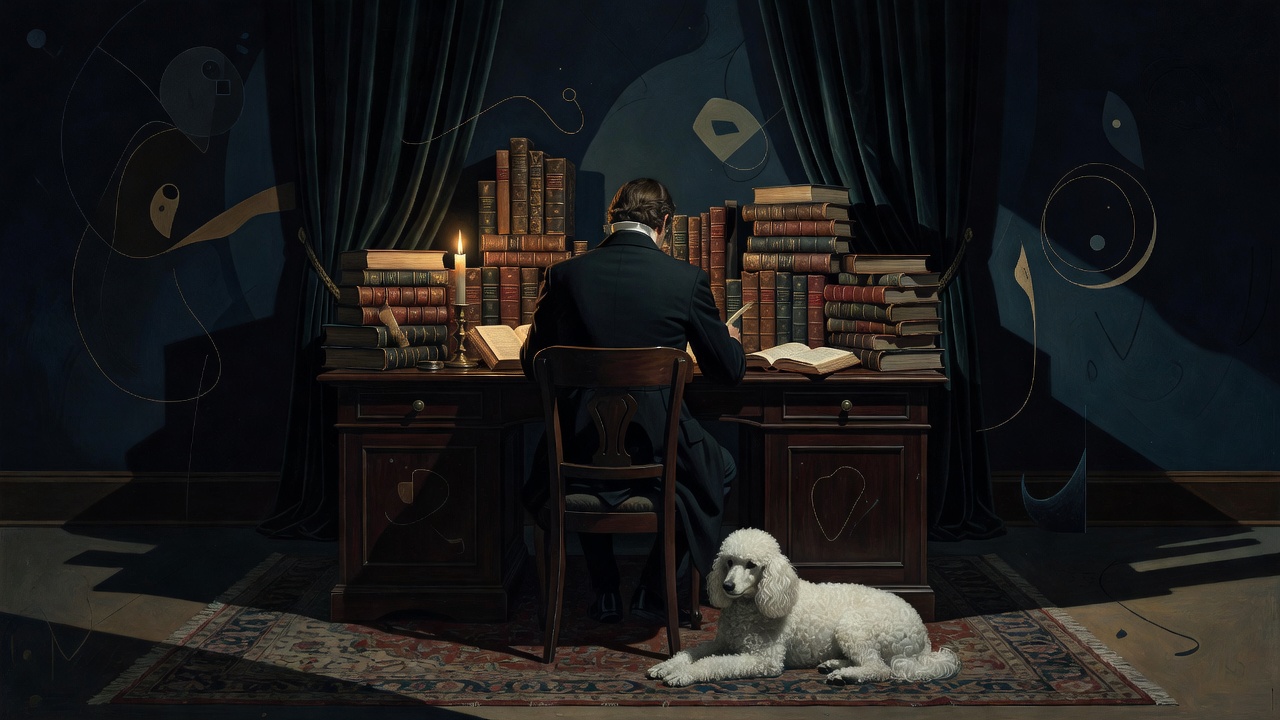
Arthur Schopenhauer spent his life arguing that existence is suffering, that the world is driven by a blind, insatiable will, and that the wisest response to being alive is to want less of it. He wrote the most beautiful German prose any philosopher has produced, sold almost none of it for thirty years, and then became famous just in time to enjoy the last decade of a life he had spent telling everyone was not worth wanting. He kept poodles, played the flute every day, ate enormous lunches at the same table in Frankfurt, and slept with loaded pistols by the bed.
The easy reading is that his philosophy was just his mood, that a miserable man built a metaphysics of misery and mistook it for the truth. The profile complicates that. Yes, his estimated Cheerfulness sits at the 0th percentile, the actual floor of the scale. But underneath the pessimism is one of the most disciplined, capable, intellectually formidable temperaments you will find anywhere, and buried inside an Agreeableness domain scored at zero is a genuine ethic of compassion that he defended more rigorously than almost anyone before him. The interesting question is not why he was unhappy. It is how a man built like this arrived at kindness as the ground of morality while trusting no one and liking almost nobody.
These are estimated percentiles, built from his published work, his voluminous letters and marginalia, the biographical record of his feuds and routines, and the accounts of the few people who spent real time near him. Schopenhauer left an unusually clear trail, because he wrote about himself constantly and made a strong impression on everyone he antagonized.
| Domain | Estimated Percentile | What It Means |
|---|---|---|
| Openness | 55th | Spiky, not uniform: near-ceiling intellect and aesthetic sense sitting on top of a rigid daily routine and a deeply conservative streak |
| Conscientiousness | 82nd | Formidable self-discipline and self-belief; a productive, orderly machine of a man who kept the same schedule for decades |
| Extraversion | 3rd | Solitary, cold to strangers, and joyless by temperament, yet physically vigorous and combative when engaged |
| Agreeableness | 0 | Misanthropic, immodest, and litigious to the bone, with two startling exceptions that explain his ethics |
| Neuroticism | 77th | Chronic anxiety and towering anger, intellectualized into a system rather than expressed as chaos |
Openness: 55th Percentile
The middling domain score is the least honest number in the whole profile, because it is an average of facets that could not be further apart. This is the textbook case for reading facets over domains, exactly the situation where the domain average hides the story.
At the top: Artistic Interests (O2) at 93 and Intellect (O5) at 91. The aesthetic reading matters more than people expect from a philosopher of gloom. Schopenhauer played the flute daily, revered Rossini and Mozart, and gave music the highest place in his entire metaphysics, calling it a direct copy of the will itself rather than a mere representation of the world. His prose carries that musical ear on every page. The Intellect score speaks for itself: he built a complete, closed metaphysical system in his twenties and spent the rest of his life elaborating a single idea with relentless rigor.
At the bottom, and this is the surprise: Adventurousness (O4) at 1 and a low reading on Liberalism (O6) at 21. The man who overturned the optimistic idealism of his era was, in his own life, almost pathologically routine-bound and socially conservative. He rose at the same hour, wrote in the morning, played the flute before lunch, ate at the Englischer Hof, walked his poodle the same route for two hours every afternoon regardless of weather, and read the same Kant and the Upanishads year after year. His radicalism was entirely intellectual and entirely contained on the page. In politics he was a reactionary who despised the 1848 revolutionaries and lent his opera glasses to soldiers firing on the crowd. High-O5 minds do not have to be open people, and Schopenhauer is the proof: a revolutionary thinker who wanted his own days to never change.
Conscientiousness: 82nd Percentile
Here is what the miserable-genius caricature misses entirely. Schopenhauer was not a dissolute romantic collapsing under his own darkness. He was a disciplined, orderly, formidably productive man, and the Conscientiousness profile is the engine that made the pessimism into a body of work instead of a diary.
Self-Discipline (C5) at 89 and Self-Efficacy (C1) at 89 are the load-bearing facets. The self-discipline shows in the decades-long routine and in the fact that he kept writing at a professional pace through thirty years of near-total public indifference, which is the exact circumstance that stops most people. The self-belief is almost superhuman: he was convinced from the start that he was right and the entire academic establishment was wrong, and he never wavered across a lifetime of being ignored. He famously scheduled his Berlin lectures at the same hour as Hegel's, lost the contest for students catastrophically, and concluded not that he had misjudged but that the age was too stupid to know what it had. That is C1 at 89 talking.
The orderliness (C2) at 73 fits the fastidious, ritualized life. The moderate Dutifulness (C3) at 56 fits a man who honored his own code absolutely and society's obligations only when they suited him. This is a Conscientiousness profile built for solitary, self-directed mastery rather than for institutional loyalty, and it produced exactly that: one man, one system, no collaborators, no compromises, finished on his own terms.
Extraversion: 3rd Percentile
A 3rd-percentile Extraversion domain sounds like a shut-in, and the social facets bear that out: Warmth (E1) at 2, Excitement-Seeking (E5) at 3, and the Cheerfulness (E6) at 0 that anchors the whole reputation. He was cold to strangers, sought no thrills, kept almost no friends, and lived most of his adult life alone but for a series of poodles he preferred to people and named after Hindu concepts. The joylessness was not a pose. His temperament genuinely ran at the floor of positive emotion, which is a different and quieter thing than depression, and it is the raw material his philosophy worked with when it declared that pleasure is merely the brief absence of pain.
But look at the two facets that break the pattern, because they explain why he was formidable rather than merely reclusive. Activity Level (E4) sits at 69 and Assertiveness (E3) at 50. This was not a listless man. He was physically vigorous into old age, took long hard daily walks, ate and lived with gusto, and in any intellectual confrontation he was combative, dominant, and completely unintimidated. The low Extraversion is entirely social. His energy and his willingness to fight were high. That combination, a hermit's appetite for company crossed with an athlete's vigor and a duelist's readiness to attack, is why his solitude produced work with such force behind it rather than fading into passivity.
Agreeableness: 0
An Agreeableness domain at the absolute floor, and the facets earn it. Trust (A1) at 0: he assumed the worst of human motives as a matter of settled principle, built an entire anthropology on the idea that people are driven by blind selfish will, and lived accordingly. Altruism (A3) at 1 and Cooperation (A4) at 0: he was combative, litigious, and constitutionally unable to defer. The most notorious episode of his life, shoving a seamstress named Caroline Marquet down the stairs in a rage over noise outside his door and then fighting the resulting lawsuit for twenty years rather than concede, is a near-perfect expression of Anger crossed with zero willingness to yield.
Modesty (A5) at 0 completes the picture on that side. He rated himself, sincerely, among the greatest minds in human history, and the market's decades of indifference did nothing to soften the estimate. When fame finally arrived in his sixties he received it as an overdue correction, not a surprise.
And then the two exceptions, which are the most important numbers in the profile. Straightforwardness (A2) sits at 64 and Sympathy, the tender-mindedness facet (A6), at 59, both above the midpoint inside a domain otherwise scraping zero. The Straightforwardness is real: he was brutally, uncontrollably honest, incapable of flattery or diplomatic softening, which cost him socially and made his prose so bracing. The Sympathy is the genuine shock, and it is not a scoring error. Schopenhauer built his entire ethics on compassion, Mitleid, the direct sharing of another being's suffering, which he considered the sole basis of all genuine morality. He extended it explicitly to animals decades before that was fashionable, and wrote against cruelty to them with real feeling. A man who trusted no one and deferred to nothing still located the moral good in the capacity to hurt at another's pain.
Neuroticism: 77th Percentile
The two facets running near the ceiling are Anger (N2) at 93 and Anxiety (N1) at 92, and both are documented past the point of dispute. The anger was famous: the feuds, the twenty-year lawsuit, the contempt he poured on Hegel and Fichte and the whole "university philosophy" he felt had stolen his rightful audience. The anxiety was constant and specific. He kept loaded pistols by his bed, fled cities at rumors of cholera, distrusted barbers with a razor near his throat, hid his valuables, worried endlessly about his money and his health, and recorded his fears in a notebook he kept in a code of several languages.
What keeps this from reading as a chaotic profile is the low Self-Consciousness (N4) at 30. Schopenhauer did not care what people thought of him, and that is the whole difference between his Neuroticism and the paralyzed, shame-bound kind. His anxiety pointed outward, at threats to his body and his legacy, not inward at his standing in others' eyes. He could be racked with fear about disease and money and still stride into a room utterly indifferent to the impression he made, which is why the high N produced combat and productivity rather than withdrawal. Compare Nietzsche, whose profile also pairs high drive with a suffering nervous system, though Nietzsche carried far more shame and social wounding in his own Neuroticism than his great influence ever did.
The Compassion Paradox
Put the whole thing together and the contradiction that defines Schopenhauer stops looking like a contradiction. Here is a man at 0 on Trust, 0 on Modesty, 1 on Altruism, 93 on Anger, who nonetheless made compassion the foundation of ethics and meant it. How?
The answer is that his compassion was not warm, and it did not have to be. Warmth is Extraversion, and his sat at the floor. His compassion ran through the aesthetic and intellectual channels where he was strong, the near-ceiling Intellect and the genuine Sympathy facet, not through the social ones where he was empty. He did not feel fond of people. He perceived, with unusual clarity, that every living thing is trapped in the same blind striving and the same suffering he felt in himself, and the sympathy facet let that perception land as fellow-feeling rather than staying a cold observation. His ethics of compassion is what you get when a powerful mind with a real capacity for shared suffering looks squarely at a world it does not like and refuses to lie about the one thing that connects it to everything else in it.
That is also why the pessimism reads as clear sight rather than mere mood, even to people whose own temperaments run nothing like his. A man at 0 Cheerfulness and 92 Anxiety will of course find the world a vale of tears. But the same profile made him incapable of the comforting distortions the rest of us run on, incapable of flattering himself, of trusting a pleasant story, of softening a hard truth to keep the peace. He saw the striving and the suffering plainly because nothing in his temperament was working to hide them from him. He was not right about everything. But he was right about a great deal that happier, more agreeable men could not afford to notice, and the profile is why.
See Your Own Profile
Schopenhauer's profile is a lesson in why the domain scores lie and the facets tell the truth. An Agreeableness of 0 that contains a serious compassion ethic, an Openness of 55 split between genius and rigidity, a 3rd-percentile Extraversion with an athlete's energy inside it: none of that is visible until you drop below the five big numbers into the thirty underneath. Your own profile has the same hidden structure, the same facets pulling against their domain averages, the same contradictions that are not really contradictions once you can see them.
The 30-facet OCEAN personality test measures all five domains and the thirty facets beneath them, so you can find the places where your own averages are hiding the real story. It takes about 15 minutes, and basic results are free.
Take the OCEAN personality test
And if a profile like this one belongs to someone you actually have to live or work with, the disciplined, brilliant, difficult, cold-but-not-cruel type, a compatibility report maps exactly where their facets will grind against yours and where they will fit, which is more useful than any biography when the person is sitting across the table rather than safely dead for a century and a half.