Benjamin Ehrlich's The Brain in Search of Itself (O2)
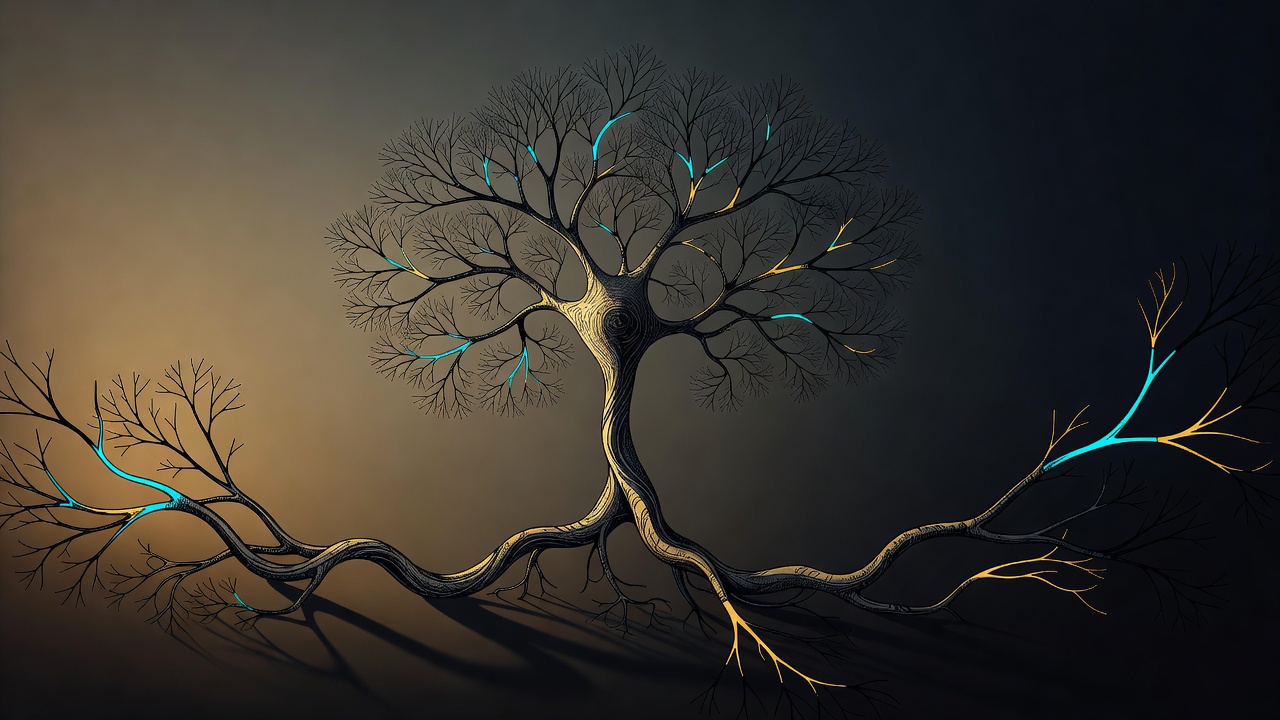
The Brain in Search of Itself, by Benjamin Ehrlich, is a biography of Santiago Ramón y Cajal, the Spanish scientist who first drew the neuron and became the father of modern neuroscience. Cajal wanted to be a painter as a boy, and he drew every cell he discovered by hand, so beautifully that his images still hang in galleries. Ehrlich came to the whole project through those drawings. In an interview with Electric Literature he recalls, "The moment when I saw his drawings was like an awakening for me." How strongly you are moved by art and beauty is, in the Big Five, one facet.
Being moved by art is the Artistic Interests facet
That facet is Artistic Interests (O2), under Openness, how much beauty and art move you and pull at your attention. A high scorer stops for a painting and feels it; a low scorer walks past. Cajal is a striking case because his art and his science were the same act, a man who could not look at a nerve cell without wanting to render it truly, and whose breakthroughs came partly from an artist's eye for form. Ehrlich's own awakening at the drawings is an O2 moment too, the aesthetic jolt that made him give years to this life.
What the book adds to the trait is a picture of how the aesthetic pull can drive discovery, not just decorate it. Cajal saw structure where others saw a blur because he was trained to look like an artist, which ties O2 to the questioning Intellect (O5) that wanted to understand what he was seeing. But the root is the artistic eye, the need to look hard at beautiful form. In Cajal the painter and the scientist were never really separate people.
For a reader placing themselves, your O2 is a fair read on how much art and beauty pull at you and how readily you stop to take them in. High on it and The Brain in Search of Itself is a kindred story, a scientist who was an artist first and never stopped being one. Low on it and the book is a window into how an aesthetic drive can shape a whole life's work. Where you sit on Artistic Interests tells you how strongly beauty moves you, and we take the facet apart in Artistic Interests (O2).
Read the book: The Brain in Search of Itself: Santiago Ramón y Cajal and the Story of the Neuron by Benjamin Ehrlich.
See Where You Fall
Where do you actually fall? The 30-facet OCEAN personality test takes about 15 minutes and scores all five domains and the facets underneath them. Take the test
Research Citations
Ehrlich, B. (2022). The brain in search of itself: Santiago Ramón y Cajal and the story of the neuron. Farrar, Straus and Giroux.
Silvia, P. J., & Nusbaum, E. C. (2011). On personality and piloerection: Individual differences in aesthetic chills and in openness to experience. Psychology of Aesthetics, Creativity, and the Arts, 5(3), 208-214.
Johnson, J. A. (2014). Measuring thirty facets of the Five Factor Model with a 120-item public domain inventory: Development of the IPIP-NEO-120. Journal of Research in Personality, 51, 78-89.
Costa, P. T., & McCrae, R. R. (1992). Revised NEO Personality Inventory (NEO-PI-R) professional manual. Psychological Assessment Resources.