Walter Mischel's The Marshmallow Test: Willpower as a Big Five Facet
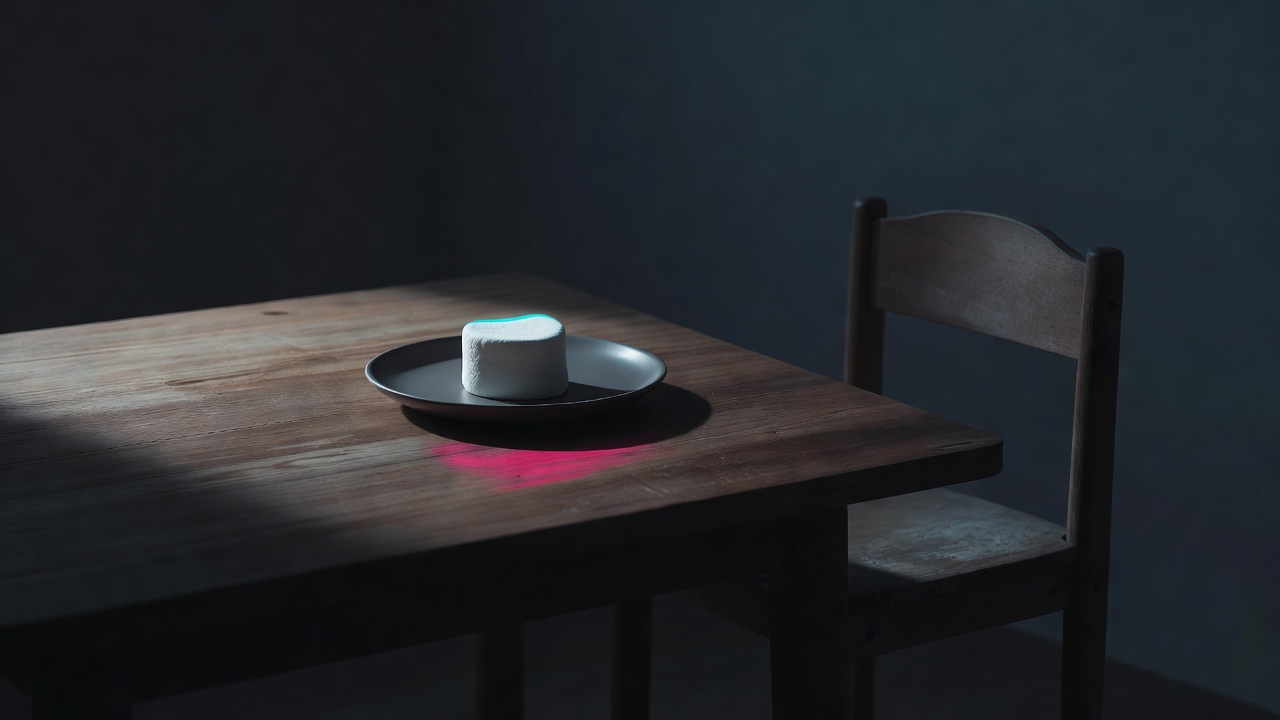
Walter Mischel's marshmallow test is the most famous willpower experiment ever run. A four-year-old sits alone with one marshmallow and a deal: wait about fifteen minutes without eating it and you get two. Some children hold out, some cave in seconds. Under the branding, what Mischel was measuring is delay of gratification, and that is one Big Five facet doing most of the work.
Willpower is the Self-Discipline facet
Self-Discipline (C5) is the facet that keeps you working, or waiting, after the impulse to stop has already arrived. It sits under Conscientiousness. The child who turns her chair away from the treat and hums to fill the time has not been handed extra willpower at birth; she is running higher C5 and, in Mischel's telling, leaning on a trick to keep the urge cool. He described the mechanism in an Education Week interview: "When the hot system is up and active, the cool system goes down. It's a reciprocal relationship." The hot system wants the marshmallow now; the cool system plans and waits, and C5 is roughly how strong that cool system runs by default.
Mischel's real argument, the one that gets buried under the cute video, is that this is teachable. He put it plainly in the same interview: "Even young students can understand that they can change how they think, and how they plan, in ways that will allow them to have greater control over what they can do." C5 is not a fixed ration. The distancing tricks the high-delay kids stumbled into can be handed to the ones who did not, which is why a low Self-Discipline score reads as a starting point rather than a verdict.
It is worth being straight about the sequel. A 2018 replication by Watts and colleagues found the marshmallow effect held up but much weaker than the legend, with a good part of its predictive power explained by a child's family background rather than raw willpower. That is a fair hit to one snack-table decision at age four. It is also the case for measuring the trait properly instead of from a single moment: one marshmallow is a noisy read on C5, while a facet score built from dozens of everyday self-control situations is a steadier one. If you want the facet on its own, we cover Self-Discipline (C5) separately.
Read the book: The Marshmallow Test: Why Self-Control Is the Engine of Success by Walter Mischel.
See Where You Fall
Where do you actually fall? The 30-facet OCEAN personality test takes about 15 minutes and scores all five domains and the facets underneath them. Take the test
Research Citations
Mischel, W. (2014). The marshmallow test: Why self-control is the engine of success. Little, Brown.
Mischel, W., Shoda, Y., & Rodriguez, M. L. (1989). Delay of gratification in children. Science, 244(4907), 933-938.
Watts, T. W., Duncan, G. J., & Quan, H. (2018). Revisiting the marshmallow test: A conceptual replication investigating links between early delay of gratification and later outcomes. Psychological Science, 29(7), 1159-1177.
Johnson, J. A. (2014). Measuring thirty facets of the Five Factor Model with a 120-item public domain inventory: Development of the IPIP-NEO-120. Journal of Research in Personality, 51, 78-89.