Type A Personality in OCEAN: What the Heart Disease Research Actually Measured

In 1959, cardiologists Meyer Friedman and Ray Rosenman published a study linking a behavioral pattern they called "Type A" to coronary heart disease. The pattern included time urgency, competitive drive, achievement obsession, and easily triggered hostility. It entered popular culture almost immediately. Within a decade, "I'm such a Type A" had become a personality label people used at dinner parties, and the research behind it got simplified into a binary: you're either Type A or Type B.
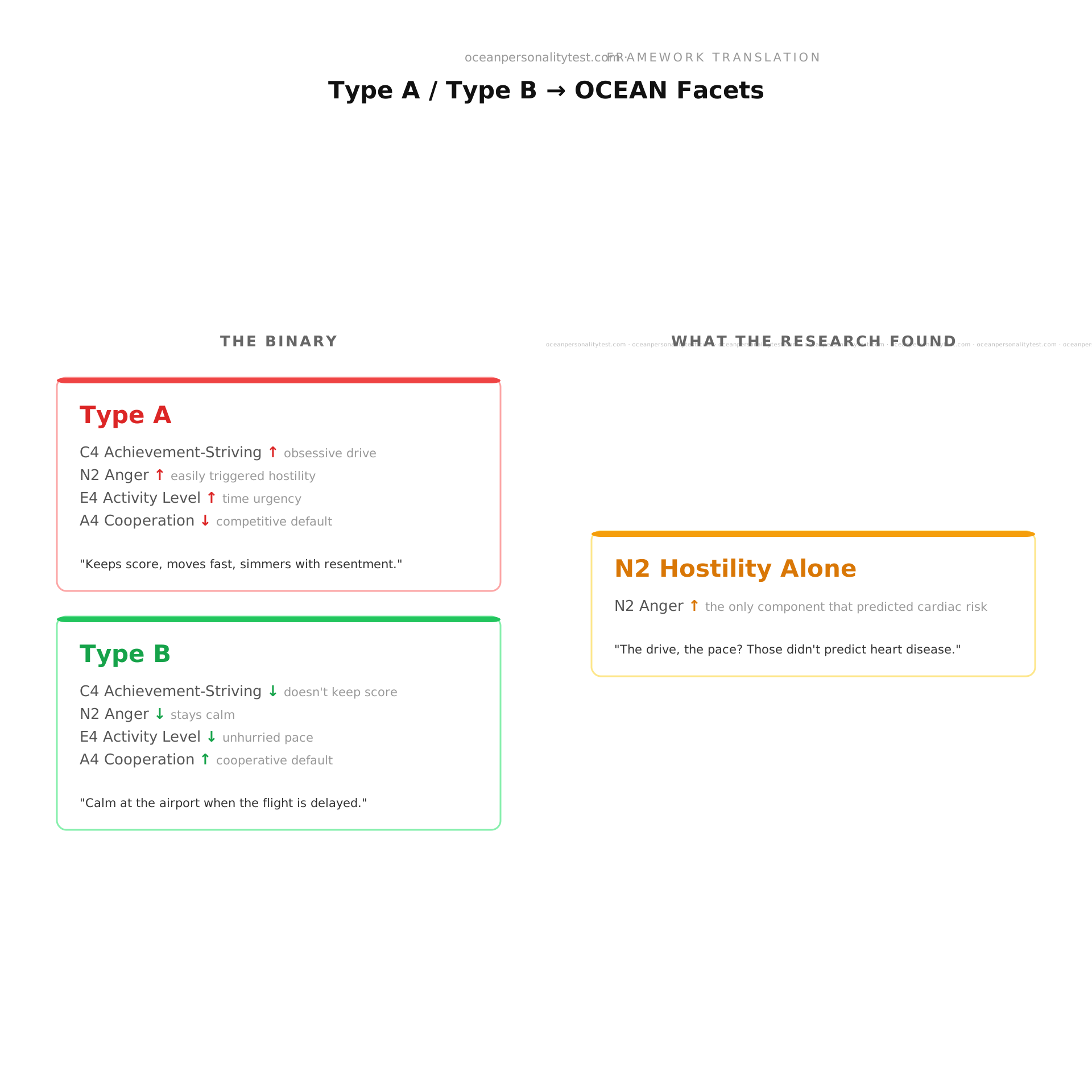
That binary was always a problem. What Friedman and Rosenman described wasn't a single trait. It was at least four independent dimensions of personality bundled together under one name. Translated into Big Five subfacets, Type A maps to high Achievement-Striving (C4), high Anger/Anger (N2), high Activity Level (E4), and low Cooperation (A4). Type B is the inverse: lower C4, lower N2, lower E4, higher A4. The person who stays calm at the airport when the flight is delayed, who doesn't keep score, who moves at a pace that would make a Type A person physically uncomfortable.
Here's where the research got interesting. Follow-up studies through the 1980s and 1990s tried to replicate the heart disease connection and kept getting mixed results. Some confirmed it; others found no relationship at all. The inconsistency forced researchers to decompose the Type A construct and test its components separately. What they found was that the cardiac risk came almost entirely from one facet: N2, Anger (the researchers called it hostility). The achievement drive, the fast pace, the competitiveness? Those didn't predict heart disease independently. The person who works 80-hour weeks but doesn't simmer with resentment when someone cuts them off in traffic was never at elevated cardiac risk in the first place.
This matters because the Type A label collapses meaningful distinctions. Someone scoring high on C4 and E4 but low on N2 is driven, fast-moving, and emotionally stable. They want to win, they work constantly, and they don't carry hostility about it. Under the Type A/B framework, they'd get classified alongside the person who scores high on all three, including the hostility. The label treats them as the same personality. Their subfacet profiles tell a completely different story.
The reverse is equally misleading. A person with high N2 but moderate C4 and low E4 is hostile but not particularly driven or active. They're not the stereotypical Type A, yet they carry the exact component that predicted the health outcomes. A Type A quiz would probably classify them as Type B, because they're not ambitious or fast-paced enough to trip the detector. The Big Five catches the hostility regardless of what else is going on.
Most "am I Type A?" quizzes are really asking a set of questions that map onto these four facets without separating them. You answer questions about impatience, competitiveness, anger, and urgency, then get a single score on a single dimension. The 30-facet OCEAN personality test gives you independent percentile scores for each: C4 tells you how achievement-driven you are, E4 tells you how much raw activity you need, N2 tells you how quickly irritation escalates to anger, and A4 tells you whether competition or cooperation is your default. Four separate measurements instead of one blended label.
The Type A construct was a useful starting point in 1959. Personality science has moved past it. The components are real, but they're independent, and they predict different outcomes. Knowing you're "Type A" tells you less than knowing your C4 is at the 90th percentile while your N2 sits at the 35th. That second profile is a person who pushes hard without the physiological cost of chronic hostility, and no binary quiz will ever surface that distinction.
Take the 30-facet OCEAN personality test and see exactly where you fall on the four facets that Type A research was trying to measure all along.