Your Conflict Style Is a Personality Trait: The Thomas-Kilmann Model Mapped to OCEAN Subfacets

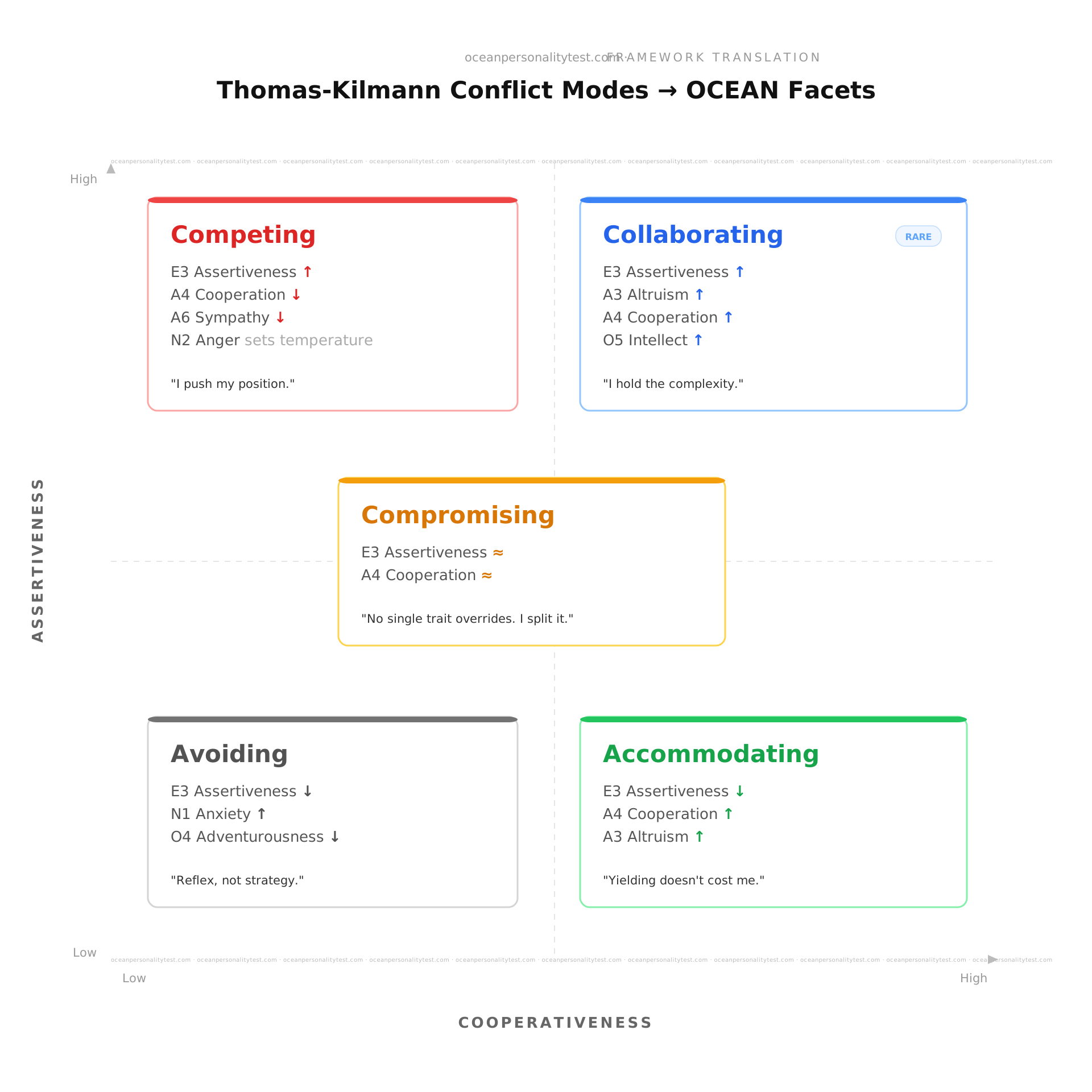
The Thomas-Kilmann Conflict Mode Instrument gives you a label. Five of them, actually, sorted by how hard you push for yourself versus how much you give ground to others. Most people walk away from the TKI knowing their default mode. Almost nobody asks what produces it.
Personality does. Each TKI mode is a predictable output of specific OCEAN subfacets, and once you see the mapping, the label stops being interesting and the wiring underneath it becomes the actual story.
Competing (high assertiveness, low cooperation) runs on E3 (Assertiveness) and low A4 (Cooperation), often with low A6 (Sympathy). The person who competes isn't deciding to be aggressive mid-conversation; the force that drives them to push their position is trait-generated, and the automatic deference that would slow them down simply isn't in their profile. What N2 (Anger) does is change the temperature: high N2 makes Competing heated, low N2 keeps it cold and surgical. Same mode, different facet driving the style of it.
Accommodating flips those two: low E3, high A4, often high A3. Yielding doesn't cost the Accommodating person the way it would cost a high-E3 person, because their profile doesn't generate the force required to hold ground. Worth noting here is that high A3 (Altruism) and low E3 accommodating can look identical from the outside but feel completely different from the inside. The A3-driven person yields and feels fine. The low-E3 person yields because asserting requires something their nervous system won't produce, and they often feel resentful afterward without being able to explain why.
Avoiding is low on both dimensions, but the OCEAN picture is more specific than that. Low E3, yes, but the defining facet is high N1 (Anxiety). Conflict activates threat detection at a volume that overrides the decision-making process before it starts. Low O4 (Adventurousness) usually compounds this: people with low O4 don't seek out uncertain situations, and conflict is the most uncertain social scenario most people ever face. The TKI frames Avoiding as a strategic choice. The OCEAN data suggests it functions more like a reflex that gets rationalized afterward.
Collaborating is high on both axes and genuinely rare, because sustaining it requires a facet combination that most profiles can't maintain under pressure. High E3 to advocate for your position. High A3 or A4 to not steamroll the other person when you're winning. High O5 (Intellect) to hold the complexity instead of defaulting to whichever compromise is closest. These three facets pulling in roughly equal strength is unusual. When people self-identify as collaborators, their OCEAN scores usually show a Compromiser who has learned to behave collaboratively in low-stakes situations and reverts under pressure.
Compromising sits in the middle of both axes, and it's the most common default for a simple reason: moderate scores are the most common scores. No single facet is extreme enough to pull the person decisively toward Competing or Accommodating, so they split the difference. This often gets read as a skill. It's closer to the absence of an overriding trait, which is also why it's the most situationally flexible position in the model.
The TKI measures behavior; the OCEAN subfacets measure the wiring that produces it. A person can learn in a workshop that Competing exists and even practice the language of it, but if E3 is at the 5th percentile, their profile won't produce Competing under actual pressure. The reverse holds: someone with A4 at the 95th percentile can fully understand that pushing back is sometimes correct, and their nervous system will still defer before the thought finishes forming.
Your 30-facet OCEAN personality test shows exactly where E3, A4, A3, A6, N1, O5, and N2 sit in your profile. The combination predicts your TKI mode more accurately than the TKI itself, because behavior is downstream of trait, and trait is what actually gets measured.
Take the 30-facet OCEAN personality test and see which conflict mode your trait combination predicts.