Regulatory Focus Theory: Promotion vs Prevention Orientation Mapped to OCEAN

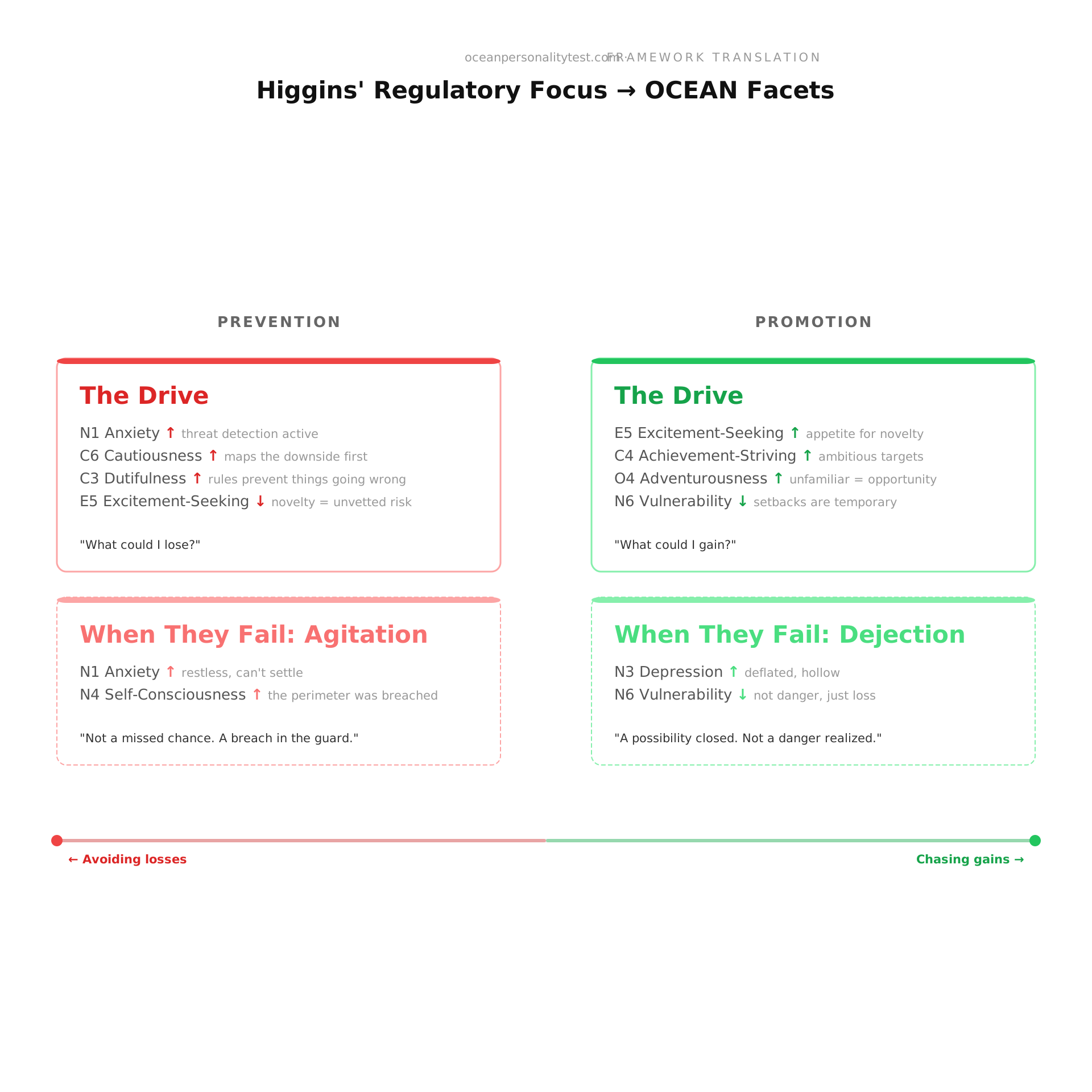
Tory Higgins proposed in 1997 that people pursue goals through one of two regulatory systems. Promotion focus orients toward gains, ideals, and advancement. Prevention focus orients toward safety, obligations, and not losing what you already have. Most regulatory focus quizzes give you a binary result or a single score on a sliding scale. But the orientation isn't one trait. It's a cluster of traits, and your OCEAN subfacets map onto that cluster with more precision than the quiz does.
Promotion focus runs on high Excitement-Seeking (E5), high Achievement-Striving (C4), high Adventurousness (O4), and low Vulnerability (N6). E5 provides the appetite for stimulation and novelty. C4 supplies the drive to reach ambitious targets rather than settle for adequate ones. O4 is what makes unfamiliar territory feel like opportunity instead of threat. And low N6 means setbacks don't register as destabilizing; they register as temporary. Put those four together and you get someone who chases possibility, tolerates risk, and rebounds fast when a bet doesn't pay off.
Prevention focus is a different architecture: high Anxiety (N1), high Cautiousness (C6), high Dutifulness (C3), low Excitement-Seeking (E5). N1 keeps the threat-detection system active. C6 slows decisions down until the downside has been fully mapped. C3 binds behavior to rules and expectations, because rules are how you keep things from going wrong. Low E5 means novelty carries no inherent reward; it's just unvetted risk. This person doesn't ask "what could I gain?" They ask "what could I lose?"
The part Higgins got most right was about emotional responses to failure. Promotion-focused people don't feel generic sadness when they miss a goal. They feel dejection, a deflated, hollow quality that comes from watching a possibility close. The emotion tracks to elevated N3 (Depression) and low N6: the loss is about what could have been, not about danger. Prevention-focused people feel something different when they fail. They feel agitation, a restless anxiety that comes from having let something slip through their guard. That response tracks to elevated N1 and N4 (Self-Consciousness): the failure isn't a missed opportunity, it's a breach in the perimeter they were supposed to maintain.
Same event, two people, completely different emotional signatures. And you can predict which one a person will experience by looking at which N facets run high.
In workplaces, the split creates a tension that most managers sense but can't name. Promotion-focused employees generate ideas, volunteer for new initiatives, push into unproven markets. They also skip steps, underestimate what can go wrong, and leave a trail of half-finished projects when something shinier appears. Prevention-focused employees catch the errors, maintain the systems, flag the risks nobody else noticed. They also resist changes that haven't been fully proven, slow down launches, and sometimes kill good ideas by over-indexing on what might break. A team stacked entirely toward one end will either move fast into walls or move so carefully it never arrives anywhere.
The binary framing is the problem. Nobody is purely promotion or purely prevention. Someone can score high on both C4 (Achievement-Striving) and C6 (Cautiousness) simultaneously, which means they pursue ambitious goals through careful execution. That profile doesn't fit either category cleanly, but it's common. Someone else might have high O4 and high N1: drawn to new experiences while running a constant anxiety signal about them. That person looks promotion-focused on the surface but feels prevention-focused internally.
The 30-facet OCEAN personality test measures each of these subfacets independently, so your results show where you sit on every axis that feeds into regulatory focus rather than collapsing it into a single label. You get E5, C4, O4, N6, N1, C6, C3, and 23 other scores that reveal the full shape of how you pursue goals, respond to failure, and manage risk.
Take the 30-facet OCEAN personality test and see whether your motivation runs on promotion, prevention, or a specific combination of both.