Perfectionism Is Three Different Patterns: Hewitt and Flett Mapped to OCEAN

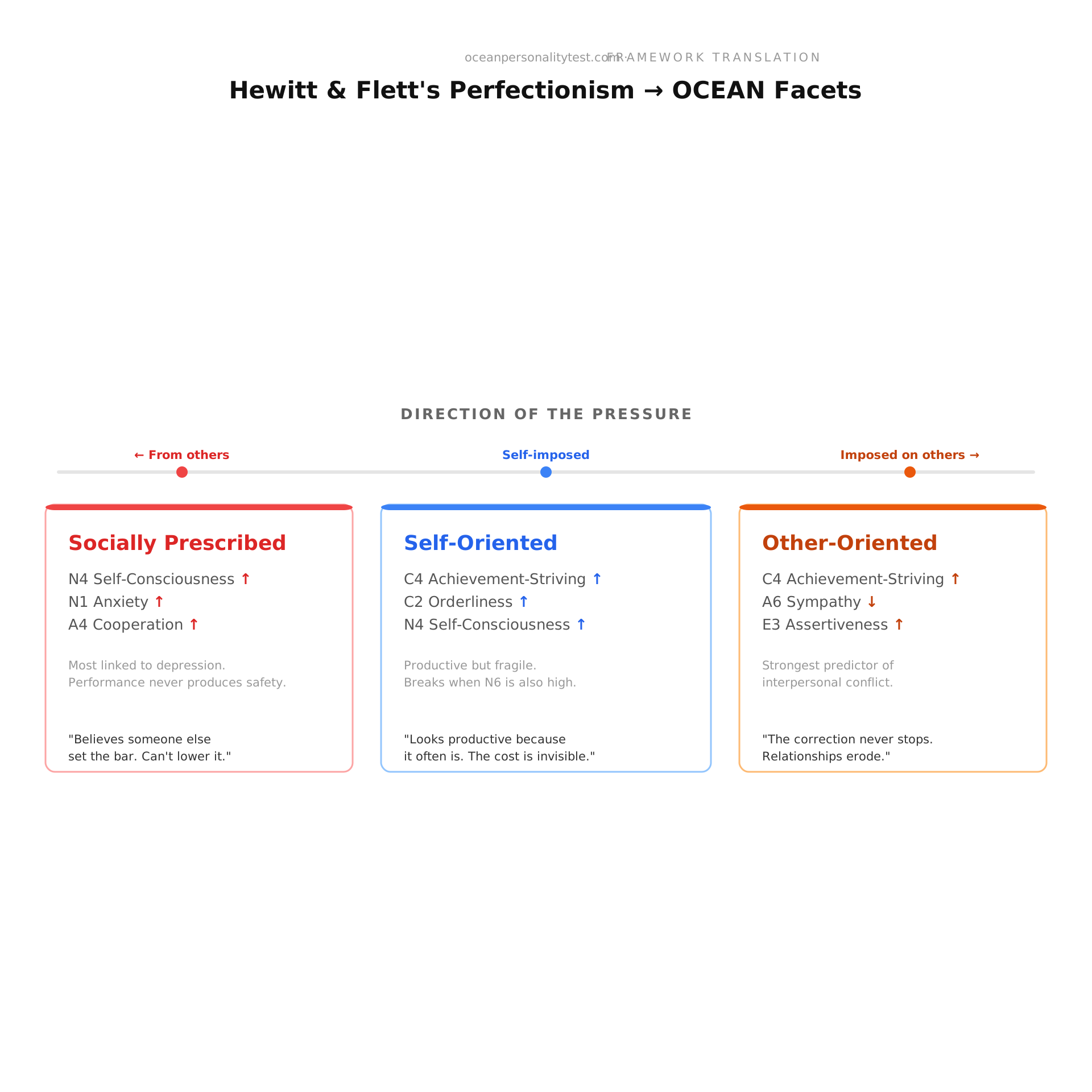
Most perfectionism quizzes tell you that you're a perfectionist. You already knew that. The more useful question is which kind, because Paul Hewitt and Gordon Flett's research identified three distinct perfectionism dimensions and they don't share the same trait structure, the same triggers, or the same damage pattern. When you map them onto the Big Five subfacets, the differences become measurable.
Self-Oriented Perfectionism
This is the one people call "the good kind." High Achievement-Striving (C4) paired with high Orderliness (C2) and elevated Self-Consciousness (N4). The person sets brutal standards, organizes their life around meeting those standards, and then watches themselves from the outside to check whether they're falling short. C4 provides the drive, C2 provides the structure, and N4 provides the surveillance.
It looks productive because it often is. These people finish things and produce consistently. But the stability of the pattern depends entirely on what else is in the profile. When high Vulnerability (N6) sits alongside it, the system has no tolerance for failure. A missed deadline or a B+ doesn't just register as a setback; it registers as evidence of something fundamentally wrong with the person. That's where burnout enters. Not from the workload, but from the emotional cost of self-monitoring that never shuts off.
Other-Oriented Perfectionism
Different engine entirely. Still high C4, because the achievement drive is there, but now it's pointed outward. Low Sympathy (A6) means the emotional cost to others doesn't register as a reason to ease up. High Assertiveness (E3) means the person has no trouble making their standards known, repeatedly, in detail.
This is the manager who rewrites your work after you've submitted it. The partner who "helps" by pointing out what you missed. They're not trying to be cruel; their internal model genuinely doesn't weight other people's frustration very heavily against the importance of getting the thing right. The research is clear on outcomes: other-oriented perfectionism is the strongest predictor of interpersonal conflict among the three types. Relationships erode not because of a single blowup but because the correction never stops.
Socially Prescribed Perfectionism
The third pattern is the most dangerous one clinically. High Self-Consciousness (N4), high Anxiety (N1), high Cooperation (A4). The person believes that other people demand perfection from them and that falling short means rejection or punishment. N4 creates the constant sense of being evaluated, and N1 amplifies every signal that the evaluation might be going badly. Meanwhile A4 keeps them trying to meet the perceived standard instead of pushing back against it.
Socially prescribed perfectionism is the type most strongly linked to depression in Hewitt and Flett's data, and the facet profile explains why. The person can't lower the bar because they believe someone else set it. Rebelling against it isn't an option either, because A4 suppresses confrontation. And N4 won't let the monitoring stop. So they perform, and perform, and the performance never produces safety because the threat is internal.
What the Quiz Misses
A perfectionism scale gives you a score on each dimension. That's useful as far as it goes. What it doesn't tell you is which specific trait is the load-bearing one in your version of the pattern. Two people can both score high on self-oriented perfectionism, but if one is driven primarily by C4 and the other by N4, they need different interventions. The first person needs permission to lower their standards. The second person needs the self-surveillance to quiet down; their standards might actually be reasonable, but the monitoring system treats every outcome as a referendum on their worth.
Same problem with the socially prescribed type. If N1 is the dominant facet, the anxiety itself is the treatment target. If A4 is running the show, the person needs to learn that disagreement won't destroy the relationship. The perfectionism label is the same; the underlying machinery is not.
The 30-facet OCEAN personality test measures C4, C2, N4, N6, A6, E3, N1, A4, and 22 other subfacets that interact with perfectionism patterns. Your results show whether you're a perfectionist, which traits are driving it, how intensely each one runs, and where the structure is most likely to crack under sustained pressure.
Take the 30-facet OCEAN personality test and find out which perfectionism pattern your facet scores actually produce.