Narcissism Mapped to OCEAN: What the Dark Triad Looks Like in Big Five Facets

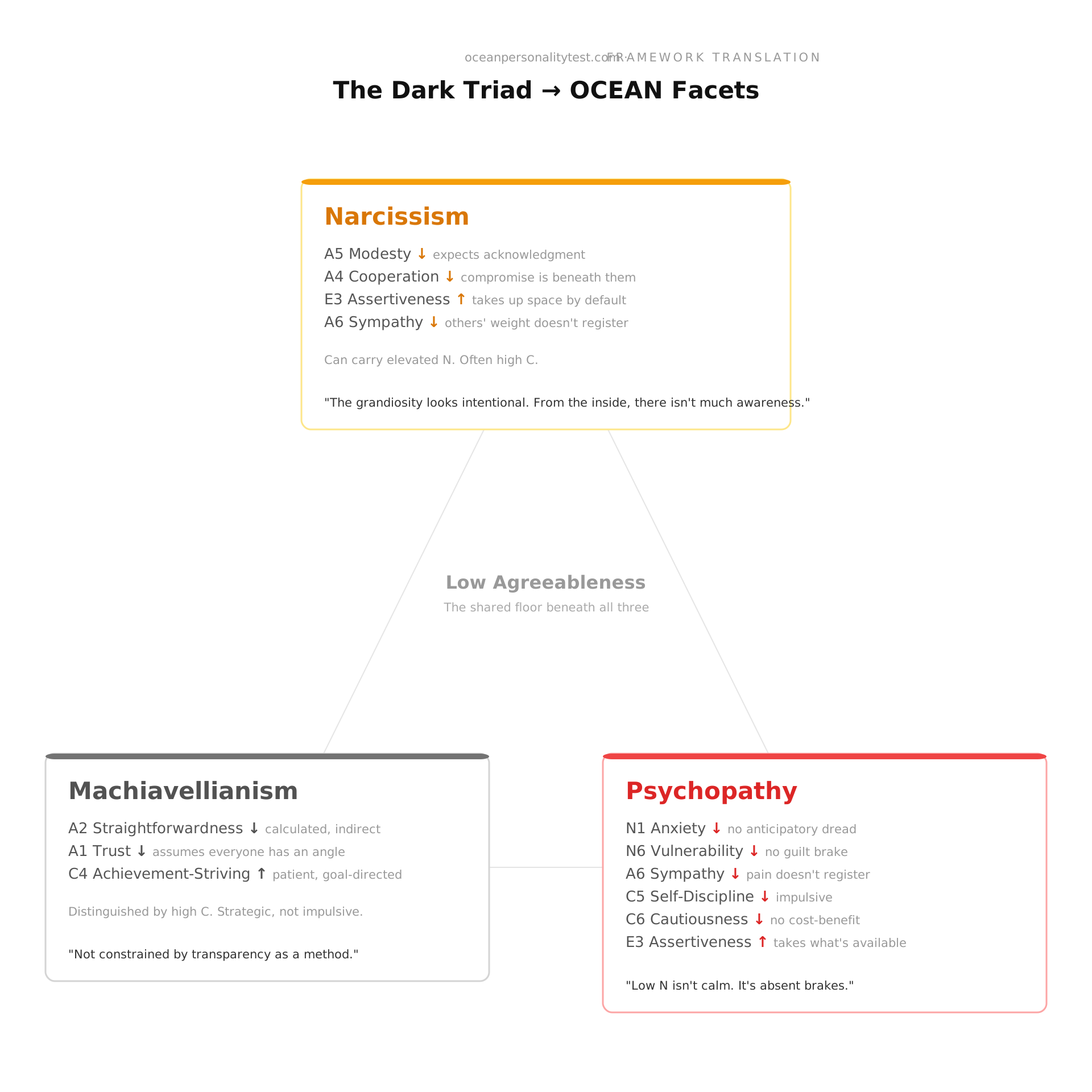
The Dark Triad gets treated as a single category, but Narcissism, Machiavellianism, and Psychopathy each have a different fingerprint in the Big Five. They overlap in a few places and diverge sharply in others. That distinction matters if you're trying to understand what you're actually measuring.
Narcissism, in its grandiose form (the version the Dark Triad describes), maps to five facets. The core is low Modesty (A5) and high Assertiveness (E3): someone who does not downplay their achievements or abilities, expects acknowledgment without prompting, and takes up space by default rather than by strategy. Low Sympathy (A6) removes the feedback loop that would otherwise register other people's experience. What makes it grandiose rather than vulnerable is the Neuroticism side: low Anxiety (N1) and low Self-Consciousness (N4) mean there is no shame brake, so the grandiosity runs outward without fear of exposure. The same low-Agreeableness core paired with high anxiety instead produces the vulnerable (covert) subtype. From the inside, there often isn't much awareness that other people's experience deserves weight.
Machiavellianism maps differently. The core is low Straightforwardness (A2), which measures whether someone is candid and genuine versus calculated and indirect. Low A2 combined with low Trust (A1) produces someone who assumes other people are also playing an angle. The wrinkle that distinguishes Machiavellianism from the other two: high Achievement-Striving (C4). This isn't impulsive or disorganized. The manipulation is patient, goal-directed, and tied to a clear outcome. Strategic deception lives in the gap between low A2 and high C4. The person knows what they want and does not feel constrained by transparency as a method for getting it.
Psychopathy has the most distinctive OCEAN signature because of what's absent in the Neuroticism domain. Most people with low scores across N feel calmer and more resilient; that's normal and healthy. In psychopathy, low N reflects an absence of guilt, anxiety, and the anticipatory dread that typically functions as a brake on harmful behavior. Low N across all facets, especially Anxiety (N1) and Vulnerability (N6), combined with very low Sympathy (A6) is the pattern. Add low Conscientiousness facets, particularly Self-Discipline (C5) and Cautiousness (C6), and you get impulsivity without remorse. High Assertiveness (E3) again, but here it reads differently than in narcissism: less about needing recognition, more about taking what's available.
The practical distinction worth keeping in mind: these three share low Agreeableness as common ground, but diverge on Neuroticism and Conscientiousness. A narcissist can have middling or even high Conscientiousness. A Machiavellian tends to. A psychopath typically does not. And the Neuroticism profile is almost inverted between narcissism (which can carry elevated N in the form of hostility and angry episodes) and psychopathy (which tends to suppress N across the board).
None of this means the OCEAN test is a clinical diagnostic. It measures trait variation in normal populations, not personality disorders. Someone with low A5, low A4, and high E3 may just be a competitive person with limited patience for social niceties. The architecture that narcissism runs on is the same architecture that produces confident, high-performing people who are difficult to work with. The facet scores show the configuration; context and behavior fill in the rest.
The 30-facet OCEAN personality test scores all of these facets independently: Modesty, Cooperation, Straightforwardness, Trust, Sympathy, Assertiveness, Achievement-Striving, and every Neuroticism subfacet. If you're trying to understand your own profile or someone else's, the extended results map each facet with percentile scores and show where the pattern sits.
Take the 30-facet OCEAN personality test and see where your own Agreeableness and Neuroticism facets land.