Moral Foundations and Personality: Why Your Politics Are Partly Wired

People assume they arrived at their political beliefs through reason. They read, they thought, they weighed the evidence. Jonathan Haidt's moral foundations theory says otherwise: moral judgments come first, and reasoning follows to justify them. The interesting part is that the foundations themselves map onto measurable personality traits, which means your political orientation is partly a readout of your OCEAN subfacet scores.
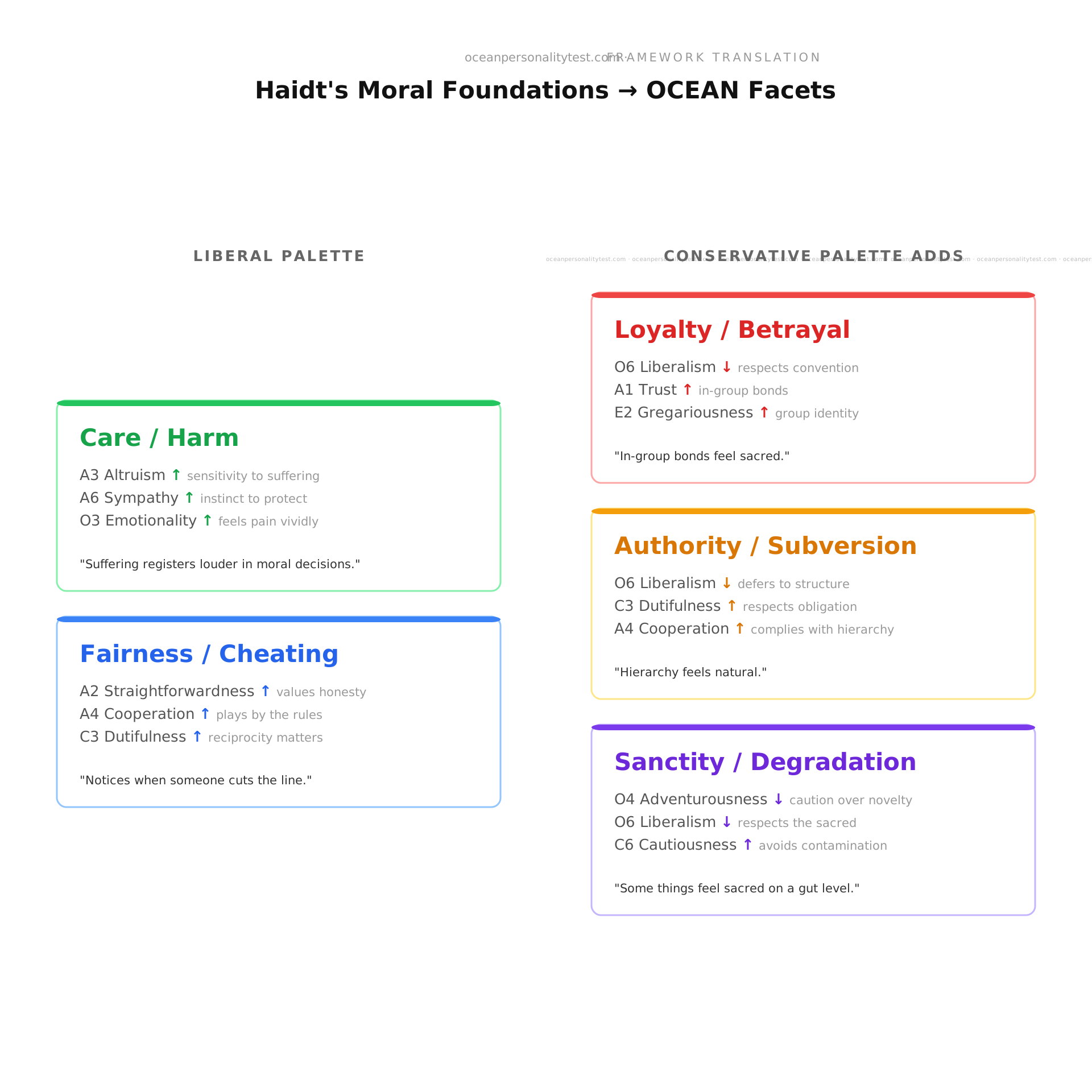
Haidt originally identified five moral foundations. Care/Harm is the sensitivity to suffering, the instinct to protect the vulnerable. In OCEAN terms, that's Altruism (A3), Sympathy (A6), and Emotionality (O3) working together. High scorers on these facets feel other people's pain more vividly and weight it more heavily in moral decisions. Fairness/Cheating is the second foundation: a concern with justice, reciprocity, and playing by the rules. That maps to Straightforwardness (A2), Cooperation (A4), and Dutifulness (C3). These are people who keep score, who notice when someone cuts the line.
The next three foundations are where the political split gets measurable. Loyalty/Betrayal tracks with low Liberalism (O6), high Trust within one's in-group (A1), and Gregariousness (E2). Authority/Subversion follows a similar pattern: low O6, high Dutifulness (C3), high Cooperation (A4). Someone who scores low on O6 respects convention and hierarchy by default; combine that with high C3 and A4, and you get a person whose moral compass points toward order, structure, and legitimate authority. Sanctity/Degradation rounds it out with low Adventurousness (O4), low Liberalism (O6), and high Cautiousness (C6). This is the foundation that makes certain things feel sacred or contaminating on a gut level, and it runs on traits that favor caution over novelty.
The research finding that keeps replicating is this: Openness, especially O6 (Liberalism), is the single strongest personality predictor of political orientation. High O6 tracks with liberal views. Low O6 tracks with conservative views. This is not a value judgment; it's a measurement, as stable as the correlation between height and weight. Agreeableness predicts compassion-based policy preferences. Conscientiousness predicts order-based policy preferences. Both "sides" of the political spectrum are running on trait structure, not on who thought harder about the issues.
Haidt's central insight was that liberals weight Care and Fairness far more heavily than the other foundations, while conservatives weight all five foundations more equally. The OCEAN subfacets explain the mechanism behind that asymmetry. When O6 and A6 dominate someone's moral palette, Care and Fairness become the entire moral vocabulary. When O6 is low and C3 and C6 are high, the palette expands to include loyalty, authority, and sanctity. Neither palette is wrong. They're just built from different trait configurations, and the configurations are measurable.
This also explains why political arguments feel so unproductive. You're not arguing about facts; you're arguing across different moral palettes generated by different trait structures. Someone high in O6 genuinely cannot feel the pull of the Sanctity foundation the way someone low in O4 and O6 does. Someone high in A6 genuinely weights suffering differently than someone whose A6 sits at the 30th percentile. The disagreement is real, and it's partly biological.
Knowing where your foundations sit doesn't change your politics. But it does change how you understand the person across the table. Their moral convictions aren't stupidity or malice; they're a different configuration of the same thirty facets you carry.
The 30-facet OCEAN personality test measures O6, A6, C3, C6, and every other subfacet that feeds your moral foundations. Take it and see which foundations your trait structure actually supports.