The MBTI-to-OCEAN Translation Table: What Your Four Letters Actually Mean in Science
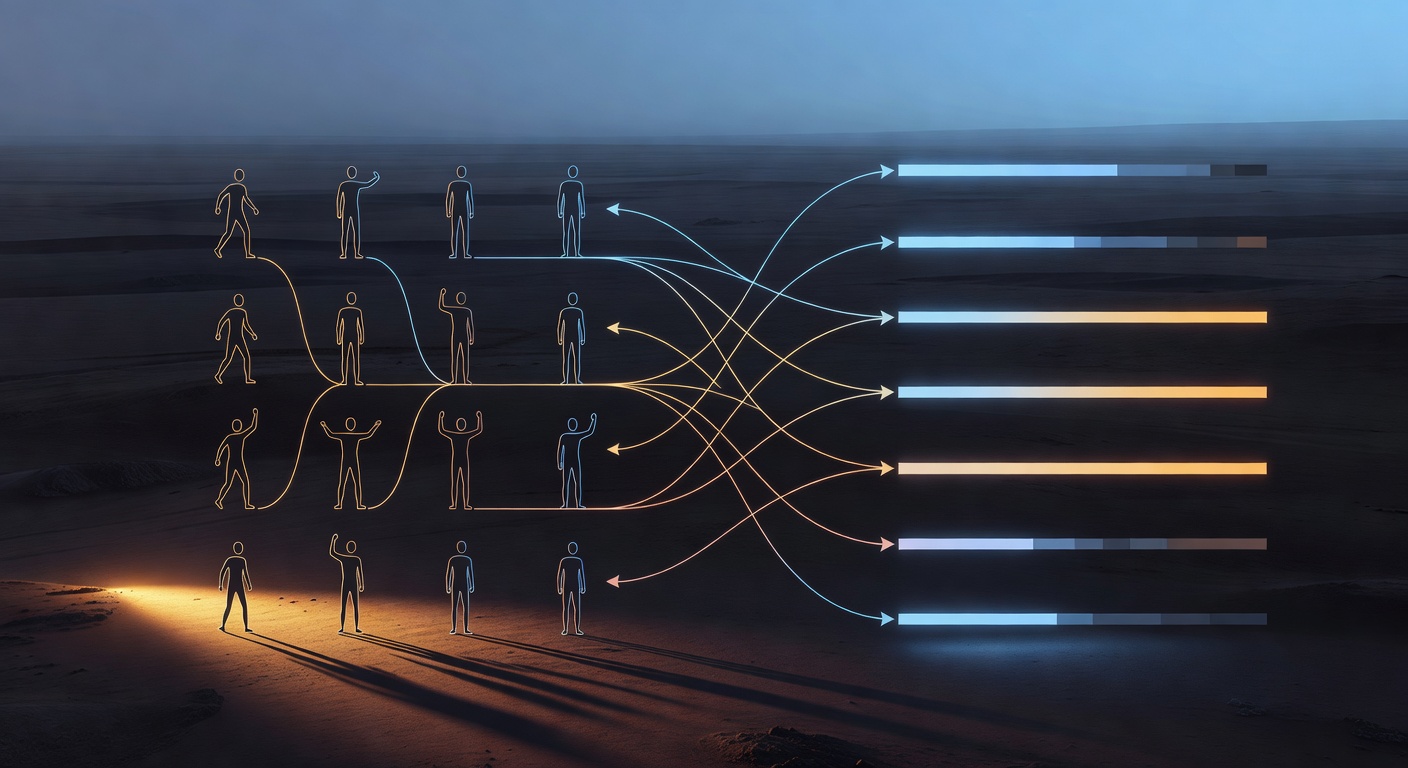
The four MBTI letters are not random categories. Each one maps to a specific Big Five dimension, and the mapping has been validated across multiple large-sample studies (McCrae & Costa, 1989; Furnham, 1996; MacDonald et al., 1994). The translation is not perfect, because MBTI forces continuous traits into binary categories, but the correspondence is strong enough that knowing your MBTI type tells you roughly where you sit on four of the five OCEAN dimensions.
The Four Letters Decoded
E/I (Extraversion/Introversion) maps directly to OCEAN Extraversion. This is the cleanest correspondence in the entire system. MBTI Extraverts score higher on E1 (Warmth), E2 (Gregariousness), E3 (Assertiveness), E4 (Activity Level), E5 (Excitement-Seeking), and E6 (Cheerfulness). The correlation is around r=0.74, which is remarkably high for two independently developed instruments. What MBTI loses is the facet breakdown: an MBTI "E" could be high on Gregariousness but low on Assertiveness, and you'd never know.
S/N (Sensing/Intuition) maps to OCEAN Openness to Experience. MBTI Intuitives score higher on O1 (Imagination), O2 (Artistic Interests), O5 (Intellect), and O6 (Liberalism). Sensors score lower across these facets. The correlation is around r=0.72. This is the dimension where MBTI does the most damage by forcing a binary, because Openness has six facets that vary independently. Someone high on Intellect (O5) but low on Imagination (O1) gets labeled the same "N" as someone high on both.
T/F (Thinking/Feeling) maps to OCEAN Agreeableness. MBTI Feelers score higher on A1 (Trust), A3 (Altruism), A4 (Cooperation), A6 (Sympathy). Thinkers score lower. The correlation is around r=0.44, which is the weakest of the four and reveals a real problem: MBTI collapses empathy, trust, compliance, and altruism into one binary when these are four independent capacities. You can be highly empathetic (high A6) and completely uncooperative (low A4). MBTI cannot represent this.
J/P (Judging/Perceiving) maps to OCEAN Conscientiousness. MBTI Judgers score higher on C2 (Orderliness), C3 (Dutifulness), C5 (Self-Discipline), and C6 (Cautiousness). Perceivers score lower. The correlation is around r=0.49. The loss here is that MBTI cannot distinguish between someone who is disciplined but disorganized (high C5, low C2) and someone who is organized but impulsive (high C2, low C6). Both get labeled "J" or "P" based on whichever tendency is slightly stronger.
The Missing Fifth Dimension
MBTI has no equivalent for Neuroticism. This is arguably its biggest blind spot. Two people can both be INFJ and differ by 80 percentile points on Anxiety, Anger, Depression, and Vulnerability. One INFJ is calm, resilient, and emotionally steady. The other is anxious, easily overwhelmed, and prone to depressive episodes. MBTI treats them as the same type. The Big Five does not.
Neuroticism is the single strongest predictor of relationship dissatisfaction, job burnout, and mental health outcomes in the personality literature. Leaving it out of a personality framework is like building a weather model that doesn't measure temperature.
The 16 Types as OCEAN Profiles
Every MBTI type translates to a predictable OCEAN profile. The profiles below are based on the letter-to-dimension mappings above, cross-referenced with empirical data from studies that administered both instruments to the same participants.
| MBTI | O | C | E | A | Pattern |
|---|---|---|---|---|---|
| INTJ | High | High | Low | Low | The strategic loner. High Intellect (O5), high Self-Discipline (C5), low Warmth (E1), low Cooperation (A4). |
| INTP | High | Low | Low | Low | The absent-minded theorist. High Intellect (O5) with low Orderliness (C2) and low Gregariousness (E2). |
| ENTJ | High | High | High | Low | The commanding visionary. High Assertiveness (E3), high Achievement-Striving (C4), low Modesty (A5). |
| ENTP | High | Low | High | Low | The debater. High Intellect (O5) and Assertiveness (E3) with low Self-Discipline (C5) and low Cooperation (A4). |
| INFJ | High | High | Low | High | The principled introvert. High Imagination (O1), high Dutifulness (C3), low Gregariousness (E2), high Altruism (A3). |
| INFP | High | Low | Low | High | The idealistic dreamer. High Emotionality (O3) and Imagination (O1) with low Orderliness (C2) and low Assertiveness (E3). |
| ENFJ | High | High | High | High | The charismatic mentor. High Warmth (E1), high Altruism (A3), high Dutifulness (C3). Scores high on almost everything except Neuroticism (which MBTI doesn't measure). |
| ENFP | High | Low | High | High | The enthusiastic connector. High Imagination (O1), high Excitement-Seeking (E5), low Self-Discipline (C5). Starts everything, finishes selectively. |
| ISTJ | Low | High | Low | Low-Mod | The reliable executor. Low Imagination (O1), high Orderliness (C2), high Dutifulness (C3), low Excitement-Seeking (E5). |
| ISFJ | Low | High | Low | High | The quiet caretaker. Low Intellect (O5), high Dutifulness (C3), low Assertiveness (E3), high Sympathy (A6). |
| ESTJ | Low | High | High | Low | The manager. Low Openness across the board, high Orderliness (C2), high Assertiveness (E3), low Cooperation (A4). Runs the system, doesn't question it. |
| ESFJ | Low | High | High | High | The community builder. Low Liberalism (O6), high Dutifulness (C3), high Warmth (E1), high Altruism (A3). Follows convention and cares deeply about others within it. |
| ISTP | Low | Low | Low | Low | The pragmatic mechanic. Low across most dimensions. High on Adventurousness (O4) despite low overall Openness; a concrete risk-taker, not an abstract one. |
| ISFP | Low-Mod | Low | Low | High | The gentle artist. Moderate Artistic Interests (O2), low Self-Discipline (C5), low Assertiveness (E3), high Sympathy (A6). |
| ESTP | Low | Low | High | Low | The adrenaline operator. Low Imagination (O1), low Cautiousness (C6), high Excitement-Seeking (E5), low Cooperation (A4). |
| ESFP | Low | Low | High | High | The performer. Low Intellect (O5), low Orderliness (C2), high Gregariousness (E2), high Cheerfulness (E6), high Warmth (E1). |
What the Table Reveals
Several patterns emerge. First, the "NT" types (INTJ, INTP, ENTJ, ENTP) all share high Openness and low Agreeableness but diverge sharply on Conscientiousness and Extraversion. An INTJ and an ENTP are supposed to be in the same "temperament" group, but their OCEAN profiles differ on two of five dimensions. Second, the "SF" types (ISFJ, ESFJ, ISFP, ESFP) all share high Agreeableness and low Openness, which means their social warmth comes from compliance and empathy rather than intellectual curiosity. Third, every type that includes "P" has lower Conscientiousness, confirming that the J/P axis is primarily measuring discipline and organization.
The table also shows why MBTI compatibility charts don't work. "INFJ is most compatible with ENTP" is a claim that high-O, high-C, low-E, high-A pairs well with high-O, low-C, high-E, low-A. Under the compatibility framework, that pairing has good complementarity on E3 (Assertiveness) but a structural clash on C2 (Orderliness) and A4 (Cooperation). Whether it works depends on facet-level scores that MBTI doesn't provide.
The 30-facet OCEAN personality test measures everything the MBTI attempts to capture plus Neuroticism, at the subfacet level instead of the binary level. If you know your MBTI type, your OCEAN profile will confirm the parts your type gets right and reveal the parts it collapses or ignores.
Take the 30-facet OCEAN personality test and see what your four letters actually look like when measured properly.