Learned Helplessness Has a Facet Profile: Seligman's Model in OCEAN Scores

Seligman figured out something uncomfortable in the 1960s: if an animal learns that its actions don't change outcomes, it stops acting. Even when the cage door opens. The finding transferred to humans almost perfectly, and the construct he built around it, learned helplessness, became one of the most cited models in clinical psychology. What he never had access to was the subfacet architecture underneath it. The Big Five gives us that.
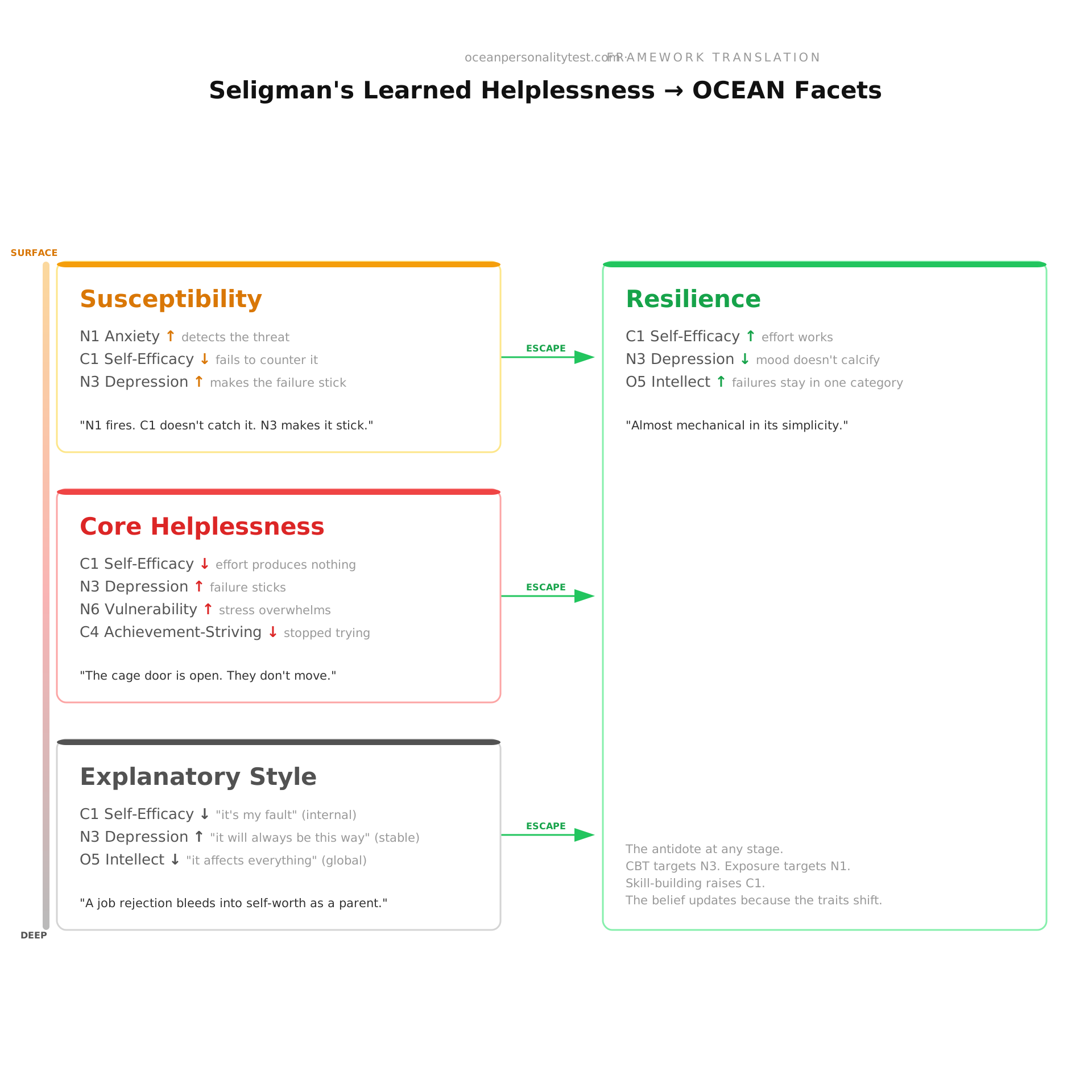
The core of learned helplessness lives in four facets. Low Self-Efficacy (C1) is the load-bearing wall: the belief that effort produces nothing. High Depression (N3) makes the emotional response to failure stick instead of passing through. High Vulnerability (N6) means stress doesn't just register, it overwhelms. Low Achievement-Striving (C4) is the behavioral output, the person who stopped trying because the system trained them to stop. C1 is the belief, N3 is the mood, N6 is the nervous system's surrender threshold, and C4 is the visible result.
But there's a layer before the helplessness sets in. The susceptibility profile looks different from the full-blown version. High Anxiety (N1) provides the initial threat signal. Something goes wrong, and N1 fires. In a resilient person, that signal gets caught by high C1: "I can handle this." In a helplessness-prone person, low C1 lets the signal pass unchallenged. N3 then converts the failed experience into a mood state that persists long after the event itself is over. The sequence matters. N1 detects the threat; low C1 fails to counter it; N3 makes the failure feel permanent.
Seligman added explanatory style to the model later. People who attribute bad events to internal, stable, and global causes are the ones who develop helplessness. "It's my fault, it will always be this way, and it affects everything." Each of those attributions has a facet correlate. Internal attribution maps to low C1: the person locates the cause of failure inside their own incompetence rather than in circumstances. Stable attribution maps to high N3, because depression makes states feel like traits. The bad feeling doesn't pass, so the person concludes it never will. Global attribution maps to low Intellect (O5): the inability to compartmentalize a failure, to keep it contained to one domain. When O5 is low, a job rejection bleeds into self-worth as a parent, a partner, a friend. The failure becomes total.
The inverse profile is resilience, and it's almost mechanical in its simplicity: high C1, low N3, high O5. The person believes their effort works. When something goes wrong, the mood doesn't calcify. And they can hold a failure in one category without letting it contaminate the rest of their life. Seligman's own later work on "learned optimism" is essentially a training program to move people toward this facet configuration.
Here's where it gets clinically interesting. Two people can both score as learned helpless on Seligman's measures and have completely different facet profiles underneath. One has rock-bottom C1 with moderate N3; that person's problem is a competence collapse. They genuinely believe nothing they do matters, but their mood would recover quickly if they could be shown evidence that their effort produces results. The other has sky-high N3 with only slightly low C1; that person's problem is a mood collapse. They might intellectually acknowledge they have skills, but the depression is so thick that the acknowledgment can't reach the part of the brain that generates action. Same label on the questionnaire. Different interventions entirely. The first person needs mastery experiences, small wins stacked until C1 shifts. The second person needs the mood addressed first, because no amount of evidence will penetrate N3 at the 95th percentile.
N6 acts as an amplifier in both cases. When Vulnerability is high, each new stressor arrives with more force than the person can absorb. Low-N6 individuals experience the same setback as a problem to solve; high-N6 individuals experience it as proof that the world is unmanageable. Pair that with low C1 and you get someone who is both easily overwhelmed and unable to believe they can do anything about being overwhelmed.
The 30-facet OCEAN personality test measures all six of these subfacets and shows you where each one sits relative to the general population. Not a binary "helpless or not," but the actual measurements: how low your C1 runs, how sticky your N3 is, whether your O5 is high enough to contain failures or low enough to let them spread.
Take the 30-facet OCEAN personality test and see where your scores sit on the facets that drive learned helplessness, resilience, and everything between them.