How Social Media Platforms Measure Your OCEAN Profile

You have never taken a personality test on YouTube, TikTok, or Instagram. But the algorithm knows your Big Five profile anyway. It knows how agreeable you are, how open to experience, how conscientious, how neurotic. It knows this because you told it. Not with a questionnaire. With every video you watched to the end, every comment you liked, every creator you followed, and every piece of content you scrolled past.
This is not speculation. Research published in the Proceedings of the National Academy of Sciences demonstrated that Facebook likes alone can predict Big Five personality traits more accurately than a person's coworkers, friends, or family members can. With enough likes (around 300), the algorithm predicted personality more accurately than the person's spouse. Social media engagement is, functionally, a personality test you take continuously without knowing it.
The interesting part is not that platforms collect this data. It is that you can read the same signals yourself, in any comment section, on any viral video. Every comment with thousands of likes is a personality referendum. Here is how it works.
The Comment Section Is a Personality Lab
A comment on a viral video is a public statement of identity. When someone writes "I would never do that," they are broadcasting low novelty-seeking. When someone writes "Just do it, stop overthinking," they are broadcasting high assertiveness and low deliberation. The comment itself is interesting. But the like count is where the real data lives.
A comment with 20,000 likes means 20,000 people saw that comment and thought "that is me." They self-selected into a personality cluster by pressing a button. The algorithm records every one of those presses. It does not need to know why you liked the comment. It just needs to know that you did, and that 19,999 other people with similar engagement patterns did the same thing.
This is what researchers call behavioral residue. You leave traces of your personality in every digital interaction, and those traces are more reliable than self-report because you are not trying to present a particular image. You are just reacting.
Compliance and Conventions: The Openness Signal
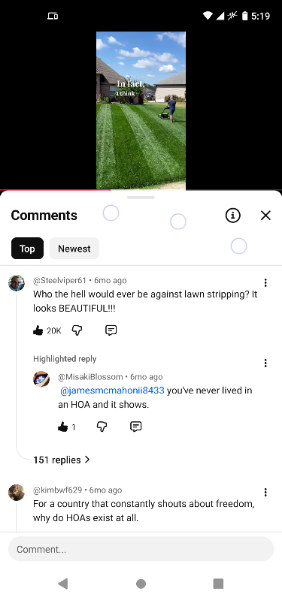
This video shows a woman who gave a researcher access to her personal computer instead of her work computer. The top comments reveal something specific: a strong reaction to the violation of conventional boundaries. "Giving access to your personal computer over the office ones needs a Psychology study" (118 likes). "Yikes, she gave it access to all her personal data instead of work stuff?!?" (176 likes).
What is being measured here? Openness to Experience, specifically the O6 facet (Liberalism, which in personality science refers to willingness to challenge conventions, not political leaning). People who react strongly to boundary violations, who feel visceral discomfort when someone does the unconventional thing, tend to score lower on O6. They value established protocols. They respect the line between personal and professional. The idea of voluntarily crossing that line triggers something close to disgust.
The algorithm does not label this "low O6." It does not need to. It simply notes that you engaged with content about convention-violation, and it clusters you with others who engage with similar content. Over thousands of interactions, your position on the Openness spectrum emerges with remarkable precision. Your authority comfort index, the degree to which you find rule-following natural versus constraining, is visible in which comments you like and which you scroll past.
People who score high on Openness would react differently to this same video. They might find the woman's choice amusing or relatable. They might focus on the research itself rather than the boundary violation. They would like different comments, or no comments at all. The algorithm sees both groups and serves them different content accordingly.
Tough on Crime: The Agreeableness Signal
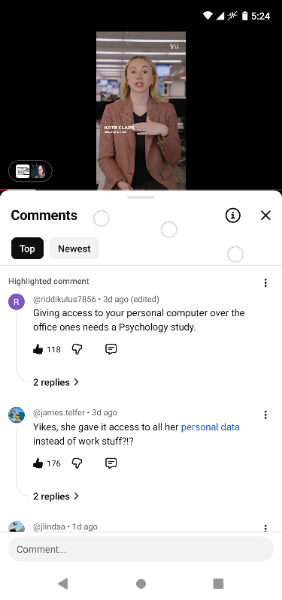
This video shows a police officer harassing a CVS employee and other citizens. The comment section explodes. "Cops like this need to be put in check because they cost the taxpayers so much money" (48,000 likes). "Harassing citizens for sitting on a bench waiting for a ride is completely tyrannical" (33,000 likes).
These numbers are not just engagement metrics. They are a mass measurement of Agreeableness, specifically the A4 facet (Cooperation) and A1 (Trust). People who score low on Agreeableness are more comfortable with confrontation, more skeptical of authority, and more willing to call out perceived injustice directly. The 48,000 people who liked that top comment are, on average, lower in trust of institutional authority and higher in willingness to challenge power structures.
This is the trust default setting in action. Some people see authority figures and default to trust: "there must be a reason the officer is doing this." Others default to suspicion: "this is an abuse of power." Your default is not a choice you make consciously. It is a trait, measurable on the A1 facet, and it determines which comments feel true to you and which feel naive or paranoid.
The algorithm learns your position on this spectrum quickly. It takes only a handful of interactions with authority-related content to build a reliable profile. If you consistently engage with content that challenges authority, you will see more of it. If you engage with content that defends institutional order, your feed will reflect that. Neither feed is "the truth." Both are personality mirrors.
What makes this particularly powerful is that the video itself is not about personality. Nobody watching this thinks "I am now revealing my Agreeableness score." They think they are reacting to a news event. But the pattern of reactions, aggregated across thousands of videos, maps directly onto the Big Five framework. The algorithm does not need personality theory. It rediscovers the same dimensions through pure behavioral data.
Trust and Suspicion: The Default Setting
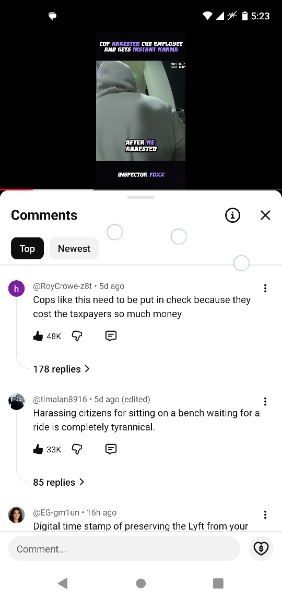
This one looks simple on the surface. A video about lawn stripping (a landscaping technique) near an HOA neighborhood. But the comment section splits into two distinct personality camps, and the split is clean enough to measure.
Camp one: "Who the hell would ever be against lawn stripping? It looks BEAUTIFUL!!!" (20,000 likes). This is the high-Openness, low-Conscientiousness response. Aesthetic appreciation (O2, Artistic Interests) combined with frustration at arbitrary rules. These people see beauty and cannot understand why anyone would regulate it.
Camp two: "You've never lived in an HOA and it shows." This is the voice of experience filtered through a specific personality lens. Higher Conscientiousness (C3, Dutifulness; C6, Cautiousness), an understanding that community rules exist for reasons, and a compliance-assertiveness gap that makes the HOA's authority feel legitimate rather than oppressive.
Then there is the third voice: "For a country that constantly shouts about freedom, why do HOAs exist at all." This is pure O6 (Liberalism) intersecting with low A4 (Cooperation). A philosophical challenge to the entire structure, not just this specific rule. The person who writes this comment and the person who likes it are measurably different, on average, from the people who defend the HOA system.
All three camps are reacting to the same 30-second video about grass. The algorithm sees three distinct engagement clusters and can predict, with surprising accuracy, how each cluster will react to unrelated content about politics, relationships, workplace dynamics, and consumer choices. Because the underlying personality traits that drive your reaction to lawn care regulations are the same traits that drive your reaction to everything else.
How Algorithms Use This
Social media platforms do not use OCEAN labels internally. They do not need to. What they build are engagement prediction models: given this user's history, what content will they watch, like, comment on, or share? The features that drive these predictions happen to align with the Big Five because the Big Five is not an invention. It is a discovery. It is the structure that emerges whenever you measure enough behavioral variation in humans.
The practical mechanism works like this. The platform tracks your behavioral residue: watch time, like patterns, comment engagement, share behavior, scroll speed, pause duration, replay frequency. It clusters you with users who have similar patterns. Then it serves you content that performed well with your cluster. The result is a feedback loop that reinforces your existing personality traits by showing you content that resonates with them.
This is not manipulation in the conspiratorial sense. It is optimization. The platform wants engagement. Engagement is maximized when content matches personality. Personality prediction is therefore the core competency of every recommendation algorithm, whether or not the engineers building it have ever heard of the Big Five.
The Engagement Personality Loop
There is a feedback effect that most people never notice. The algorithm shows you content that matches your personality. You engage with it (confirming the prediction). The algorithm refines its model of you. It shows you more of the same, but slightly more targeted. Your engagement deepens. Your personality expression on the platform becomes more concentrated, more extreme, more predictable.
This is why your feed feels like it "knows you." It does. Not because it read your mind, but because it watched your behavior long enough to build a personality model that is, according to the research, more accurate than what your friends could produce.
The metacognitive ceiling, the limit of how much of your own personality you can accurately perceive, is relevant here. Most people believe they are aware of their own traits. The data suggests otherwise. Your self-assessment of how agreeable, open, or neurotic you are is less accurate than the algorithm's assessment, because the algorithm sees your actual behavior while you see your idealized self-image.
This creates the trait awareness gap: the measurable distance between who you think you are and who your behavior reveals you to be. Your feed is on the behavior side. Your self-concept is on the idealized side. The gap between them is where the interesting psychology lives.
What Likes Reveal About Specific Facets
Each type of engagement maps to specific subfacets. Here is a partial translation guide:
What you watch to the end reveals your Openness (O4 Adventurousness, O5 Intellect). Novel, surprising, or complex content holds the attention of high-O viewers. Predictable, familiar content holds the attention of low-O viewers. The algorithm measures this through watch-time completion rates.
What you like reveals your Agreeableness (especially A1 Trust, A4 Cooperation) and Neuroticism (N2 Anger, N1 Anxiety). Likes on confrontational content signal low A. Likes on wholesome content signal high A. Likes on alarming content signal high N1. The like button is the most personality-dense signal on any platform.
What you comment on reveals your Extraversion (E3 Assertiveness, E5 Excitement-Seeking) and Conscientiousness (C4 Achievement-Striving). Commenting takes more effort than liking. People who comment frequently are measurably higher in Assertiveness and lower in self-monitoring. What they say reveals even more, but the act of commenting at all is the first filter.
What you share reveals your identity goals (O6 Liberalism, A2 Morality, C3 Dutifulness). Sharing is a public act. You share content that you want associated with your identity. The gap between what you like privately and what you share publicly is itself a personality signal, reflecting your self-consciousness (N4) and modesty (A5).
What you scroll past is the negative space, and it matters just as much. The algorithm tracks not only what you engage with but what you skip. Content you consistently ignore creates a negative profile: the traits you do not express, the topics that do not resonate, the personality space you do not occupy.
Your Feed Is Your Mirror
Try this experiment. Open your YouTube Shorts feed or TikTok For You page. Scroll through 20 videos without liking or commenting. Just observe what the algorithm chose for you. Then ask: what does this feed say about my personality? What traits would a stranger infer about me from this content selection?
If your feed is full of debate content, confrontation, and "calling people out" videos, you likely score lower on Agreeableness and higher on Assertiveness. If it is full of aesthetic content, travel, and novel experiences, you likely score higher on Openness. If it is full of productivity hacks, organization tips, and routine optimization, you likely score higher on Conscientiousness.
The feed is not random. It is a personality portrait constructed from thousands of behavioral data points, updated in real time, and more accurate than most self-assessments. The 30-facet profile you get from a formal OCEAN assessment gives you the language and precision to understand what the algorithm already knows about you. The difference is that the assessment tells you directly, while the algorithm uses the information without your knowledge or consent.
Knowing Your Actual Profile
The algorithm knows your personality. Your employer may know it too (personality assessments are used in 60% of large company hiring processes). Your social media engagement is analyzed by advertisers who target you based on predicted personality traits. The question is whether you know it yourself.
Most people have a vague sense of their personality. "I'm kind of introverted." "I'm a planner." "I'm pretty laid back." These are low-resolution summaries of a 30-dimensional space. They miss the subfacet mismatches that explain why you are "laid back" about some things and rigid about others, why you are introverted in groups but energized one-on-one, why you plan your work meticulously but make personal decisions impulsively.
The formal OCEAN assessment takes about 15 minutes. It gives you percentile scores on all 5 domains and 30 facets. Unlike the algorithm's profile, it shows you the results directly. You can see where you actually fall, compare it to where you thought you fell, and start closing the trait awareness gap between your self-image and your measured behavior.
Take the OCEAN personality test
If you have already taken it, the compatibility and team reports show you how your specific profile interacts with someone else's, including where the personality friction score between two profiles predicts real-world conflict before it happens.
The algorithm already has your profile. You might as well have it too.