DISC vs OCEAN: What Each Personality Test Actually Measures
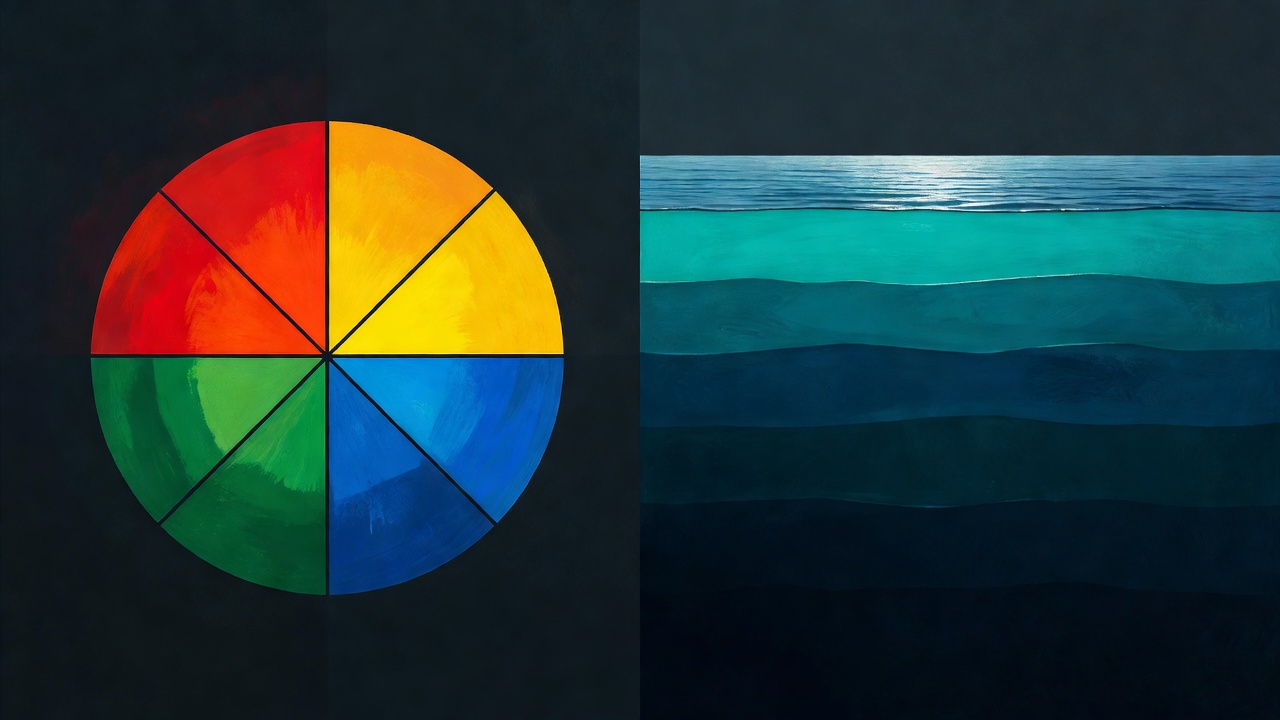
DISC is one of the most common assessments in corporate training. Millions of people take some version of it every year. It sorts you into four behavioral styles and gives a team a shared language for how its members communicate. The Big Five, also called OCEAN, almost never shows up in a Monday morning workshop. Yet it is the framework that personality scientists actually use. Both claim to describe personality. They measure very different things.
If you have taken a DISC assessment at work and wondered how it relates to a real personality test, this is the direct comparison. It covers what DISC and OCEAN each measure, where they overlap, and which one to trust for hiring, self-knowledge, or understanding the people around you.
What DISC Measures
DISC goes back to William Marston, a psychologist writing in 1928. His book Emotions of Normal People proposed that behavior falls along two axes: how you see your environment (favorable or hostile) and how you respond to it (active or passive). Modern DISC tools turned that idea into four styles.
The four letters stand for Dominance, Influence, Steadiness, and Conscientiousness. Loosely, they track how you handle four things: problems (D), other people (I), the pace of change (S), and rules (C). Most DISC reports hand you a primary letter or a blend of two and describe how that style tends to play out at work.
The key point is that DISC measures behavioral style in a setting. It describes how you tend to act, especially on a team, rather than the deeper dispositions underneath that behavior.
What OCEAN Measures
OCEAN is the Big Five model: Openness, Conscientiousness, Extraversion, Agreeableness, and Neuroticism. Each of the five is a continuous dimension, and each splits into six narrower facets, thirty in total. Instead of a style, you get a position on every trait, from very low to very high, along with the facet detail underneath each domain.
The Big Five was not designed by one person. It emerged from decades of research: analysis of the trait words that appear in human language, factor analysis of personality questionnaires, and replication across dozens of cultures. The same five factors keep appearing regardless of who runs the study. That is why it became the standard framework in academic and industrial psychology.
The Core Difference: Behavior vs. Traits
The cleanest way to understand the gap is this. DISC describes behavior in a context. OCEAN measures traits that stay relatively stable across contexts and over time.
Your DISC style can shift depending on the role you are in. Many people report one style at work and a different one at home, because DISC captures adapted behavior, and behavior adapts. A Big Five profile moves far more slowly. Your level of Conscientiousness or Neuroticism is a durable tendency that shows up whether you are in a meeting or on vacation.
So the two are chasing different questions. DISC wants to know how you tend to act on a team. OCEAN is after the part underneath that, the stuff that barely moves when you change desks or go home for the weekend.
How DISC Maps to the Big Five
Because DISC describes behavior that grows out of real traits, each DISC style has a rough Big Five signature. The mapping is not one to one, but it is close enough to translate between the two.
| DISC style | What it describes | Closest Big Five signature |
|---|---|---|
| Dominance (D) | Direct, competitive, results first | High Assertiveness (E3) and Achievement-Striving (C4), low Cooperation (A4) and Modesty (A5) |
| Influence (I) | Outgoing, persuasive, optimistic | High Warmth (E1), Gregariousness (E2), and Cheerfulness (E6), higher Openness |
| Steadiness (S) | Patient, dependable, calm | High Cooperation (A4) and Altruism (A3), low Assertiveness (E3), low Anxiety (N1) |
| Conscientiousness (C) | Precise, careful, rule oriented | High Orderliness (C2), Dutifulness (C3), and Cautiousness (C6), lower Gregariousness (E2) |
One gap stands out. DISC has no dimension for emotional stability. Two people can share the same DISC style and sit at opposite ends of Neuroticism, one calm under pressure and one easily rattled. That difference shapes almost everything about how a person handles stress, and DISC cannot see it. This is the same blind spot that MBTI has.
What DISC Gets Right
DISC deserves credit for what it is built to do. It is fast, easy to remember, and gives a team a common vocabulary within an afternoon. Telling a colleague you are a high D and they are a high S can open a useful conversation about pace and pressure that might not have happened otherwise. For a low-stakes communication workshop, that practical value is real.
The trouble starts when DISC is treated as a complete picture of personality, or used for decisions it was never validated to make.
Where DISC Falls Short
DISC has limited independent peer-reviewed validation, and its test-retest reliability tends to run lower than the Big Five. A meaningful share of people get a different primary style when they retake it, which is a problem if you are making real decisions from the result.
It is also categorical. Sorting people into four styles forces a boundary where none exists in nature, so two people with nearly identical behavior can land in different quadrants. It ignores emotional stability entirely, and it measures adapted workplace behavior, which changes with role, manager, and mood. None of that is a good foundation for predicting job performance. The trait that best predicts performance across almost every job is Conscientiousness, measured directly, which is exactly what the Big Five gives you and DISC only approximates.
When to Use Which
Use DISC for a quick team exercise: an offsite icebreaker, a shared language for how people prefer to communicate, a light-touch prompt for a group conversation. It is good at that, and nobody is harmed if the label is rough.
Use OCEAN when the stakes are higher. Hiring, coaching, self-knowledge, and relationship compatibility all need prediction and validity, not a four-letter style that can flip between sittings. When the decision matters, you want the framework the research actually supports.
Side by Side
| DISC | OCEAN (Big Five) | |
|---|---|---|
| Basis | Behavioral styles (Marston, 1928) | Trait dimensions (decades of research) |
| Dimensions | 4 styles | 5 domains, 30 facets |
| Measurement | Categorical style or blend | Continuous score on each trait |
| Emotional stability | Not measured | Neuroticism, measured directly |
| Scientific validity | Limited | Strong |
| Test-retest reliability | Low to moderate | High (.80-.90) |
| Best use | Team communication | Hiring, self-knowledge, compatibility |
DISC and OCEAN are not really rivals. DISC is a quick read on how you tend to operate at work, and it is genuinely handy for that. OCEAN is the fuller measurement that quick read skips over. If a DISC style is the only thing you have ever gotten back, the piece it leaves out, your emotional stability most of all, is the piece worth measuring next.
Research Citations
Marston, W. M. (1928). Emotions of normal people. Kegan Paul, Trench, Trubner & Co.
Barrick, M. R., & Mount, M. K. (1991). The Big Five personality dimensions and job performance: A meta-analysis. Personnel Psychology, 44(1), 1-26.
Costa, P. T., & McCrae, R. R. (1992). Revised NEO Personality Inventory (NEO-PI-R) and NEO Five-Factor Inventory (NEO-FFI) professional manual. Psychological Assessment Resources.
McCrae, R. R., & Costa, P. T. (1997). Personality trait structure as a human universal. American Psychologist, 52(5), 509-516.
Roberts, B. W., Walton, K. E., & Viechtbauer, W. (2006). Patterns of mean-level change in personality traits across the life course: A meta-analysis of longitudinal studies. Psychological Bulletin, 132(1), 1-25.
See where you actually fall. The 30-facet OCEAN personality test takes about 15 minutes and measures all five domains and the facets underneath them, including the emotional stability that DISC leaves out. Take the test