Defense Mechanisms Have Personality Signatures: Mature vs Immature Defenses in OCEAN
Everyone has a default way of handling emotions they can't sit with. Freud called them defense mechanisms. Clinicians later sorted them into tiers: mature, neurotic, immature. What nobody mapped until recently is how those tiers line up with measurable personality traits. They do, and the alignment is clean enough to predict which defenses a person reaches for under stress based on six or seven subfacet scores.
Mature defenses: what the high-functioning version looks like
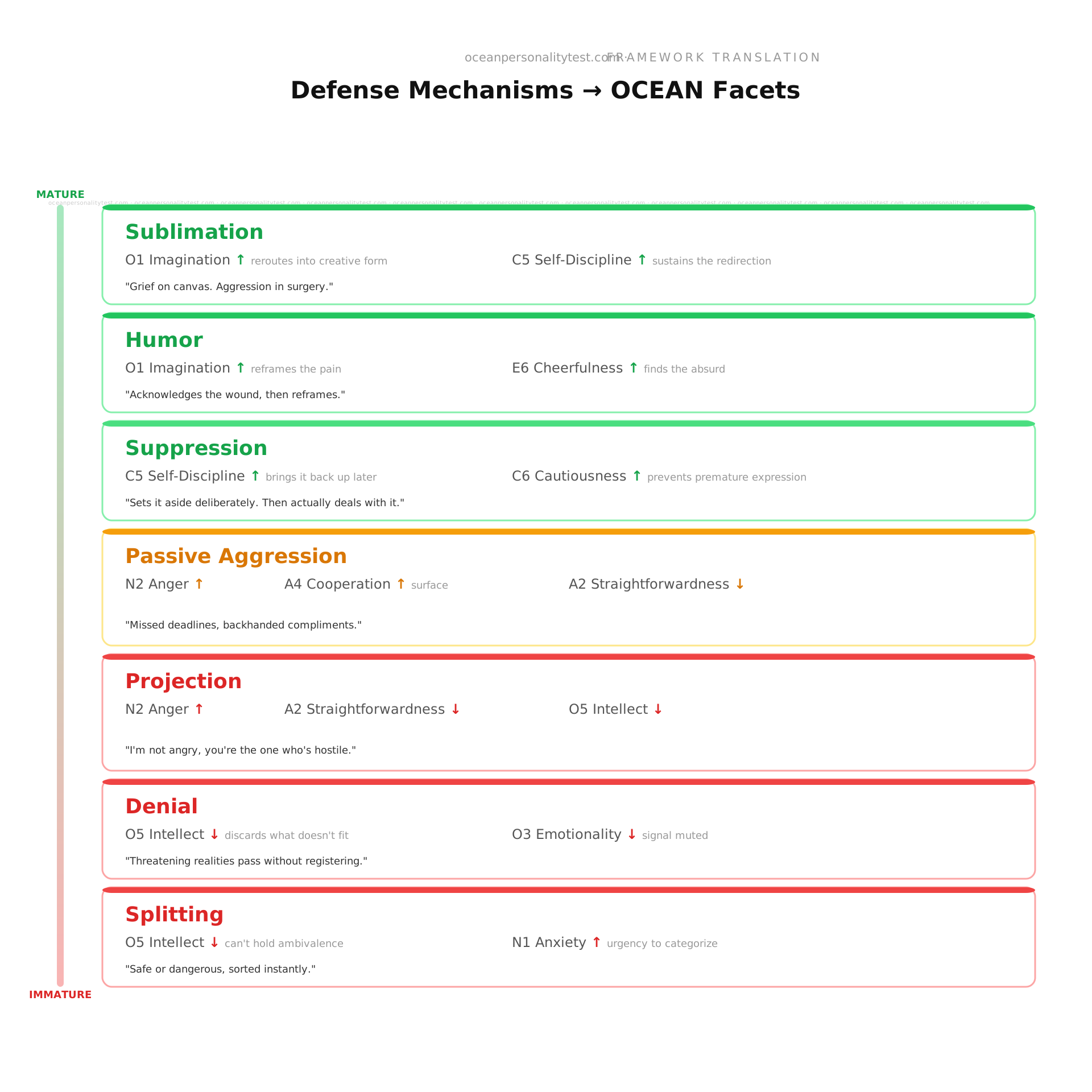
Sublimation is the one therapists love. Instead of acting on a difficult feeling, you channel it into something productive. A painter who works through grief on canvas. A surgeon whose controlled aggression saves lives. The facet signature: high Imagination (O1) combined with high Self-Discipline (C5). O1 provides the capacity to reroute emotional energy into symbolic or creative form; C5 provides the follow-through to sustain that redirection long enough for it to actually work. Without O1, the person doesn't generate alternative channels. Without C5, the redirection collapses back into raw feeling before it produces anything.
Humor as a defense mechanism (not humor as entertainment) means reframing pain without pretending it doesn't exist. The person acknowledges the wound and finds something absurd or honest in it. High O1 again, plus high Cheerfulness (E6) and a moderate level of Neuroticism awareness. E6 without any N awareness is just positivity; the defense requires contact with the painful material first, then the reframe. People who score high E6 with near-zero N scores tend to bypass rather than metabolize.
Suppression is the most misunderstood. It's not repression. Repression is unconscious. Suppression is a deliberate, conscious decision to set an emotion aside and deal with it later, and then actually dealing with it later. High Self-Discipline (C5) and high Cautiousness (C6). The person registers the feeling, decides the current moment isn't the right time, and holds it in working memory until they can process it properly. C6 is what prevents premature expression; C5 is what brings it back up when conditions improve.
Immature defenses: the facets that predict them
Denial maps to low Intellect (O5) and low Emotionality (O3). O5 is cognitive complexity, the ability to hold contradictory information without collapsing it into a simpler story. Low O5 means the person's system reduces ambiguity fast, often by discarding the information that doesn't fit. Low O3 means the emotional signal that would normally flag a problem gets muted before it reaches conscious processing. Together, these two deficits let threatening realities pass through without registering.
Projection requires a specific trio: high Anger (N2), low Straightforwardness (A2), and low Intellect (O5). The person has feelings they find unacceptable, usually hostility or envy. N2 generates the intensity. Low A2 means they lack the habit of direct self-disclosure, so the feeling can't exit through honest expression. Low O5 means they can't hold the thought "I feel this and it's mine" because that level of self-contradiction is cognitively uncomfortable. The system resolves it by reassigning the feeling to someone else: "I'm not angry, you're the one who's hostile."
Passive aggression looks compliant on the surface. High N2 produces genuine hostility. High Cooperation (A4) means the person's behavioral pattern is agreeable, cooperative, conflict-avoidant. Low Straightforwardness (A2) means they won't express the hostility directly. So the anger comes out sideways: missed deadlines, backhanded compliments, strategic incompetence. The facet profile explains why confronting a passive-aggressive person rarely works. You're asking them to override three trait scores simultaneously.
Splitting is the inability to hold ambivalence. Someone is either entirely trustworthy or a complete threat. Low O5 is the engine here; the cognitive system can't sustain a "both/and" model of another person. High Anxiety (N1) adds urgency to the categorization. When you're anxious and you can't hold complexity, you sort people into safe or dangerous as quickly as possible because the uncertainty itself is intolerable. Relationships built on splitting are intense and unstable, cycling between idealization and devaluation as new information forces reclassification.
The pattern underneath
Mature defenses cluster around high Openness (particularly O1 and O5) and high Conscientiousness. The person can imagine alternative responses, tolerate cognitive complexity, and sustain the effort required to process emotions constructively. Immature defenses cluster around low Openness and high Neuroticism. The system can't hold difficult material, so it ejects it: onto other people, into denial, into indirect expression.
This isn't a moral judgment. Trait scores are partially heritable and partially shaped by early environment. A person using immature defenses isn't choosing to; their subfacet profile makes mature alternatives genuinely harder to access. But knowing which profile you carry tells you where the work is. Someone with low O5 and high N2 who wants to stop projecting needs to build cognitive complexity and distress tolerance, not just "be more self-aware."
The 30-facet OCEAN personality test measures O1, O3, O5, C5, C6, N1, N2, A2, A4, E6, and 20 other subfacets. Your results show which defense mechanisms your profile predicts, where the mature alternatives are already accessible, and which specific facet gaps make certain defenses hard to outgrow.
Take the 30-facet OCEAN personality test and find out which defenses your personality defaults to under pressure.