Communication Styles Are Measurable: Passive, Aggressive, and Assertive in OCEAN Scores

Most communication style quizzes give you one of four labels: passive, aggressive, assertive, or passive-aggressive. You answer twenty questions about how you handle disagreements, and the quiz sorts you into a box. The problem is that the box doesn't tell you why you ended up there. Two people can both score "passive communicator" and have almost nothing in common underneath it.
The Big Five subfacets break communication style into the specific traits that produce it. Once you see which facets are driving your behavior, the label stops mattering and the mechanics become clear.
Passive Communication
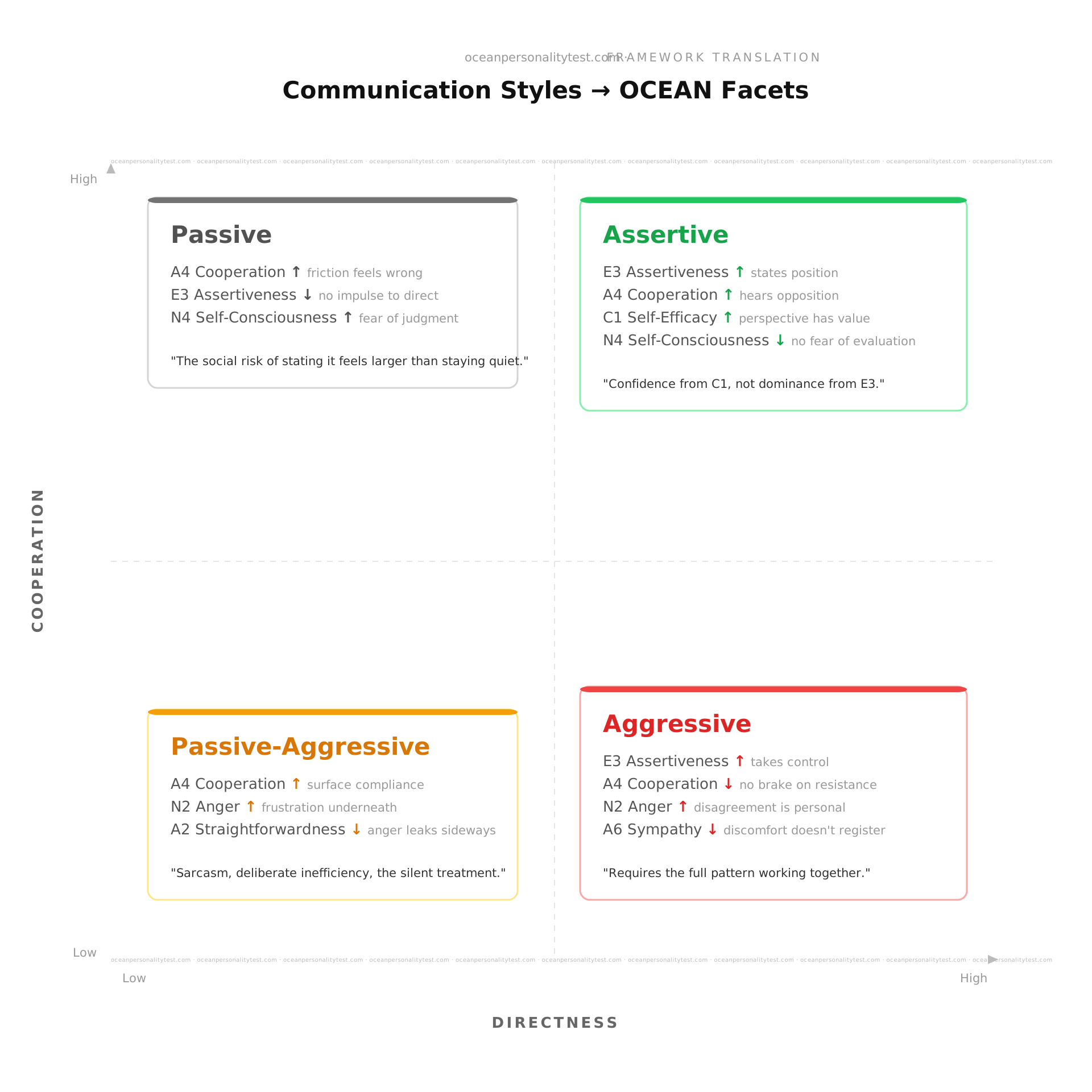
Passive communicators avoid conflict, defer to others, and struggle to voice their own needs. In facet terms, the signature is high Cooperation (A4), low Assertiveness (E3), and high Self-Consciousness (N4). A4 makes you yield in disagreements because friction feels wrong. Low E3 means the impulse to speak up and direct the conversation simply isn't there. N4 adds the fear of being judged, so even when you do have an opinion, the social risk of stating it feels larger than staying quiet.
But here's where the quiz breaks down. Someone with high Altruism (A3) and low E3 also tests as passive, yet their silence comes from a completely different place. They aren't afraid of judgment; they genuinely prioritize the other person's comfort over their own expression. The behavioral output looks the same on a quiz. The internal experience is nothing alike, and the path out of it requires different work.
Aggressive Communication
Aggressive communicators dominate conversations, dismiss opposing views, and escalate quickly. The facet profile: high Assertiveness (E3), low Cooperation (A4), high Anger (N2), and low Sympathy (A6). E3 provides the drive to take control of interactions. Low A4 removes the brake that would normally make someone back down when resistance appears. N2 supplies the heat, the readiness to interpret disagreement as a personal slight. Low A6 means the other person's discomfort doesn't register as a reason to stop.
Remove any single facet from that combination and the style changes. High E3 with normal A6 produces someone who's direct but still reads the room. High N2 with high A4 creates someone who gets angry internally but capitulates anyway. The aggression requires the full pattern working together.
Assertive Communication
Assertive communication is the one everyone wants, and it has the most balanced facet profile: moderate-to-high Assertiveness (E3), moderate Cooperation (A4), high Self-Efficacy (C1), and low Self-Consciousness (N4). E3 gives you the willingness to state your position. Moderate A4 means you can hear opposition without either folding or escalating. C1 supplies the confidence that your perspective has value, so you don't second-guess yourself mid-sentence. Low N4 keeps the fear of social evaluation from overriding the rest.
What makes this profile interesting is that C1 often matters more than E3. People assume assertiveness comes from being naturally dominant, but some of the most effective assertive communicators are only moderately extraverted. Their confidence comes from Conscientiousness, from a stable belief in their own competence; E3 just provides enough activation energy to open their mouth.
Passive-Aggressive Communication
This one is the most structurally complicated. Passive-aggressive communicators appear compliant on the surface while expressing hostility indirectly: sarcasm, deliberate inefficiency, the silent treatment. The facet profile is high Cooperation (A4) on the surface combined with high Anger (N2) underneath and low Straightforwardness (A2). A4 prevents direct confrontation because the person has internalized that open conflict is unacceptable. N2 generates the frustration anyway. Low A2 means they won't say what they actually mean, so the anger leaks out sideways through tone, timing, and omission.
A communication quiz labels this person as "passive-aggressive" and recommends they practice being more direct. That advice addresses E3 and A4, but the real driver is usually N2 paired with low A2. The anger needs somewhere to go, and the person lacks the trait structure for transparent expression. Working on directness without addressing the anger source doesn't change much.
Why Facets Are More Precise Than Labels
Communication style quizzes measure the output. Personality facets measure the inputs. A label like "passive" collapses five or six independent trait dimensions into a single word, which means it can't distinguish between the person who stays quiet out of fear (high N4), the person who stays quiet out of genuine deference (high A3), and the person who stays quiet because they simply don't have the social energy to engage (low E3 with low E1). All three get the same quiz result. All three need different things to communicate more effectively.
The 30-facet OCEAN personality test measures E3, A4, N2, N4, A2, A6, C1, and 23 other subfacets independently. Your results show the exact trait combination producing your communication pattern, not which box you fit into, but which specific facets are pulling you toward silence, directness, or something in between.
Take the 30-facet OCEAN personality test and see the trait structure underneath the way you communicate.