Cognitive Distortions Have Personality Signatures: Beck's Thinking Errors Mapped to Facets

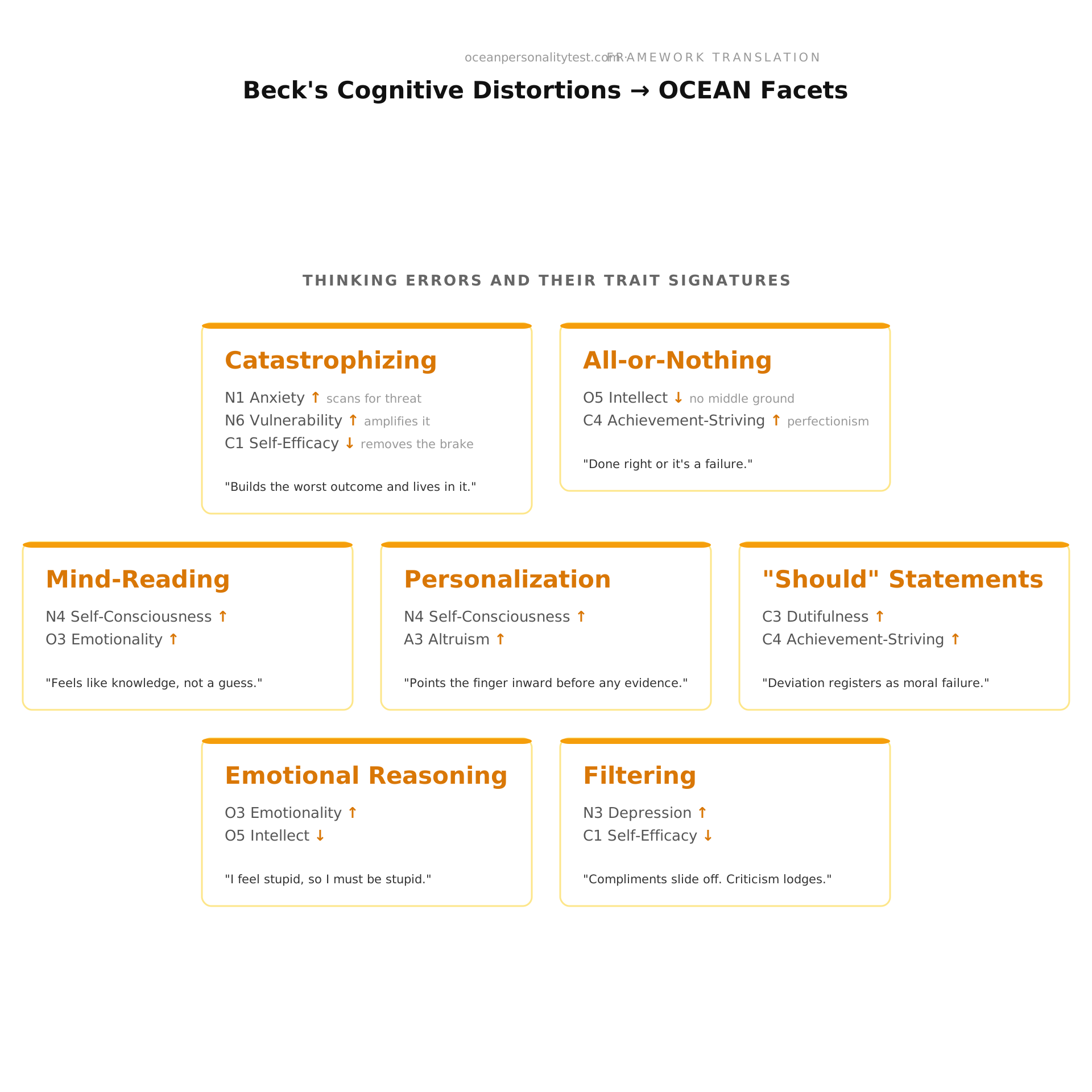
Aaron Beck catalogued cognitive distortions in the 1960s and therapists have been correcting them ever since. CBT teaches you to catch the distortion, challenge it, replace it with something more balanced. What it rarely addresses is why you keep landing on that particular distortion instead of a different one. Two people under the same stress will produce different thinking errors, and the reason is consistent enough to measure: the distortion follows the personality structure.
Catastrophizing is the clearest example. High Anxiety (N1) primes the nervous system to scan for threat. High Vulnerability (N6) amplifies whatever it finds, turning a possible problem into an imminent one. Low Self-Efficacy (C1) removes the internal brake that would normally say "I can handle this." When all three converge, the person doesn't just worry; they build a complete model of the worst outcome and experience it as if it's already happening. CBT can interrupt this in a session. But if you don't know the facet combination generating it, you're pulling weeds without seeing the root system.
All-or-nothing thinking has a different signature entirely. Low Intellect (O5) reduces cognitive complexity, the capacity to hold two contradictory evaluations at once. High Achievement-Striving (C4) adds perfectionism on top of that reduced complexity. The result: things are either done right or they're failures, people are either reliable or worthless, a day is either productive or wasted. There's no middle category because the trait structure doesn't generate one.
Mind-reading runs on high Self-Consciousness (N4) paired with high Emotionality (O3). N4 creates a persistent model of how others perceive you. O3 fills that model with emotional detail. Together they produce a confident, vivid sense of what someone else is thinking, especially about you. The person isn't guessing; it feels like knowledge. That's what makes it so resistant to correction.
Personalization pulls from a different combination: high N4 again, but now paired with high Altruism (A3). The self-consciousness provides the assumption that you're being evaluated. A3 adds a reflexive sense of responsibility for others' emotional states. When something goes wrong in a group, this combination points the finger inward before any evidence arrives. "Should" statements follow a similar conscientiousness pathway. High Dutifulness (C3) and high Achievement-Striving (C4) create an internal rulebook so rigid that any deviation registers as moral failure, not just suboptimal performance.
Emotional reasoning, the conviction that feeling something makes it true, maps to high Emotionality (O3) with low Intellect (O5). O3 generates strong internal signals. O5 is what would normally subject those signals to scrutiny. When O5 is low, the feeling arrives and gets accepted at face value: "I feel stupid, so I must be stupid." And filtering (discounting the positive) is the signature of high Depression (N3) combined with low Self-Efficacy (C1). N3 creates a negative attentional filter; C1 removes the confidence that would let a positive experience stick. Compliments slide off. Criticism lodges.
The pattern across all of these is the same: the distortion is not a random error in processing. It's a predictable output of a specific facet configuration. Beck identified the outputs. The Big Five identifies the inputs. That's the piece CBT typically leaves on the table, because knowing which distortion to watch for is useful, but knowing why your brain keeps producing that one (and not the six others on the list) changes what you can actually do about it.
The 30-facet OCEAN personality test scores you on all the subfacets mentioned here: N1, N3, N4, N6, C1, C3, C4, O3, O5, A3, and 20 others. Your results show which cognitive distortions your trait structure is wired to produce, not as a diagnosis, but as a map of where your thinking will bend under pressure.