Attachment Theory Mapped to OCEAN: What Your Attachment Style Looks Like in Facet Scores

Attachment quizzes hand you a category. The Big Five gives you the measurements underneath it, which is why your OCEAN subfacet scores predict your attachment style more precisely than most of those quizzes do. The quiz measures what you do; the personality test measures the trait structure that makes you do it.
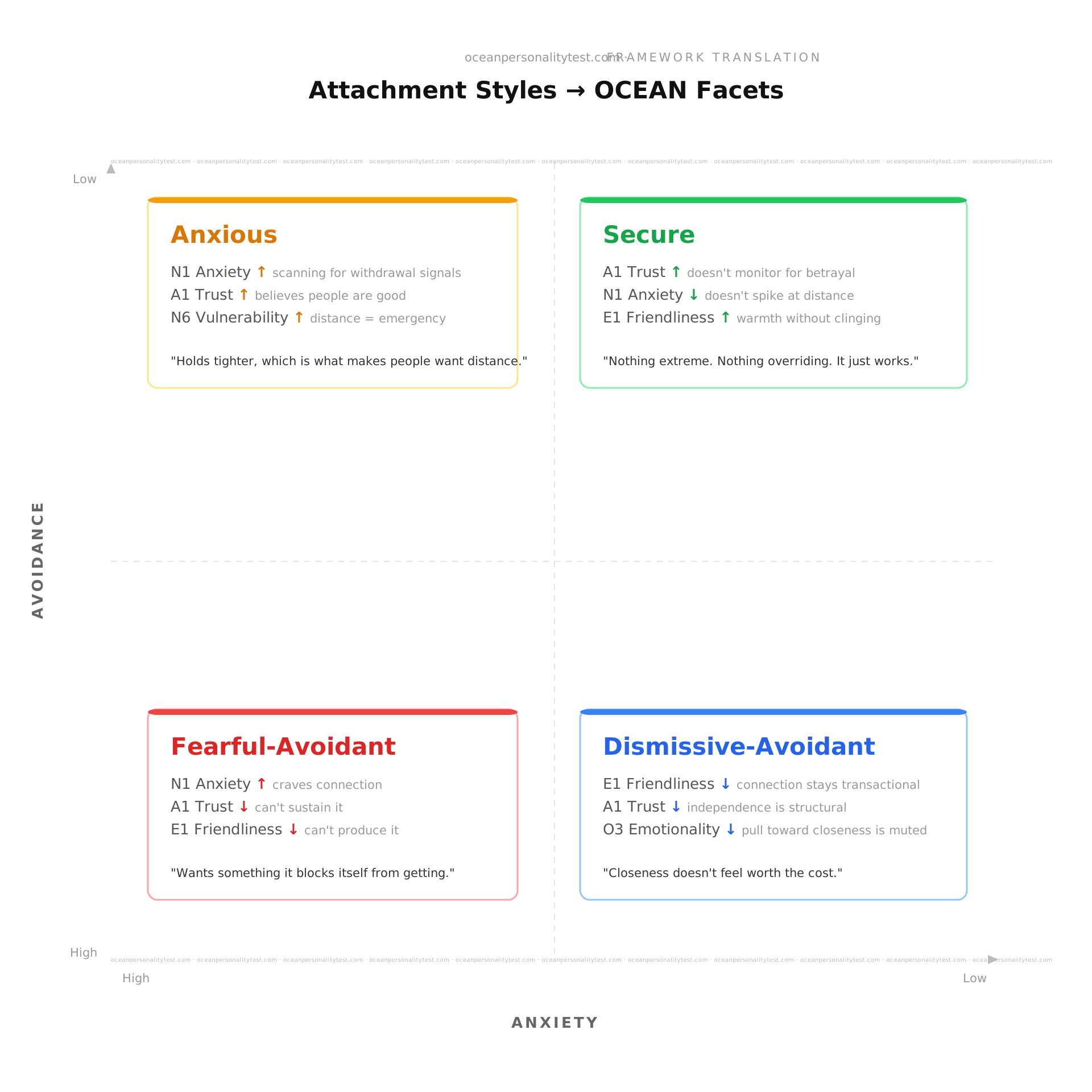
Secure attachment sits at moderate Trust (A1), low Anxiety (N1), and moderate Warmth (E1). Nothing extreme. The person doesn't monitor for betrayal, doesn't spike when there's some distance, doesn't pull others in so close they suffocate. It works because the facets are in a functional range and none of them overrides the others.
Anxious attachment is a specific combination: high Anxiety (N1), high Trust (A1), high Vulnerability (N6). You believe people are fundamentally good and you're terrified they'll leave anyway. The Trust keeps you bonded. Anxiety has you scanning every interaction for withdrawal signals. When a small distance registers, N6 sends it to your nervous system as an emergency, so you hold on tighter, which is usually the thing that makes people want distance in the first place.
Dismissive-avoidant maps to low Warmth (E1), low Trust (A1), low Emotionality (O3). Warmth is what makes other people feel welcome; without it, connection stays transactional. Trust is what allows dependence; without it, independence stops being a preference and becomes structural. Low O3 means the internal pull toward closeness is muted before it reaches awareness. The avoidance isn't a wall. It's the absence of the thing that would make closeness feel worth having.
Fearful-avoidant is the hardest one: high N1 with low A1 and low E1. The anxiety creates the craving for connection. The low warmth and low trust mean the person can't produce it or sustain it. So the system wants something it blocks itself from getting. Getting closer triggers the threat response; pulling away triggers the longing. That loop runs until something external breaks it.
Where attachment quizzes break down is intensity. Two people can both test as anxious attachment, but if one scores N1 at the 70th percentile and the other at the 98th, they're having different experiences of the same label. One worries. The other's nervous system is reorganizing their entire day around managing the threat signal. The quiz doesn't distinguish them. The facet scores do.
The 30-facet OCEAN personality test measures A1, N1, E1, O3, N6, and 25 other subfacets, and your results include an attachment style interpretation based on where those specific facets sit relative to each other. Not a label. The measurements under the label, including which facet is driving it and how strongly it runs.
Take the 30-facet OCEAN personality test and see what your attachment style and emotional intelligence look like in facet scores.