Assertiveness Is Not One Thing: The Four Communication Modes in OCEAN Scores

Most people think of assertiveness as a dial from low to high. Either you speak up or you don't. That framing misses the actual structure of how communication style works, which is why "work on being more assertive" so rarely produces lasting change. The behavior is the output of several independent traits. Changing the output means knowing which input is the problem.
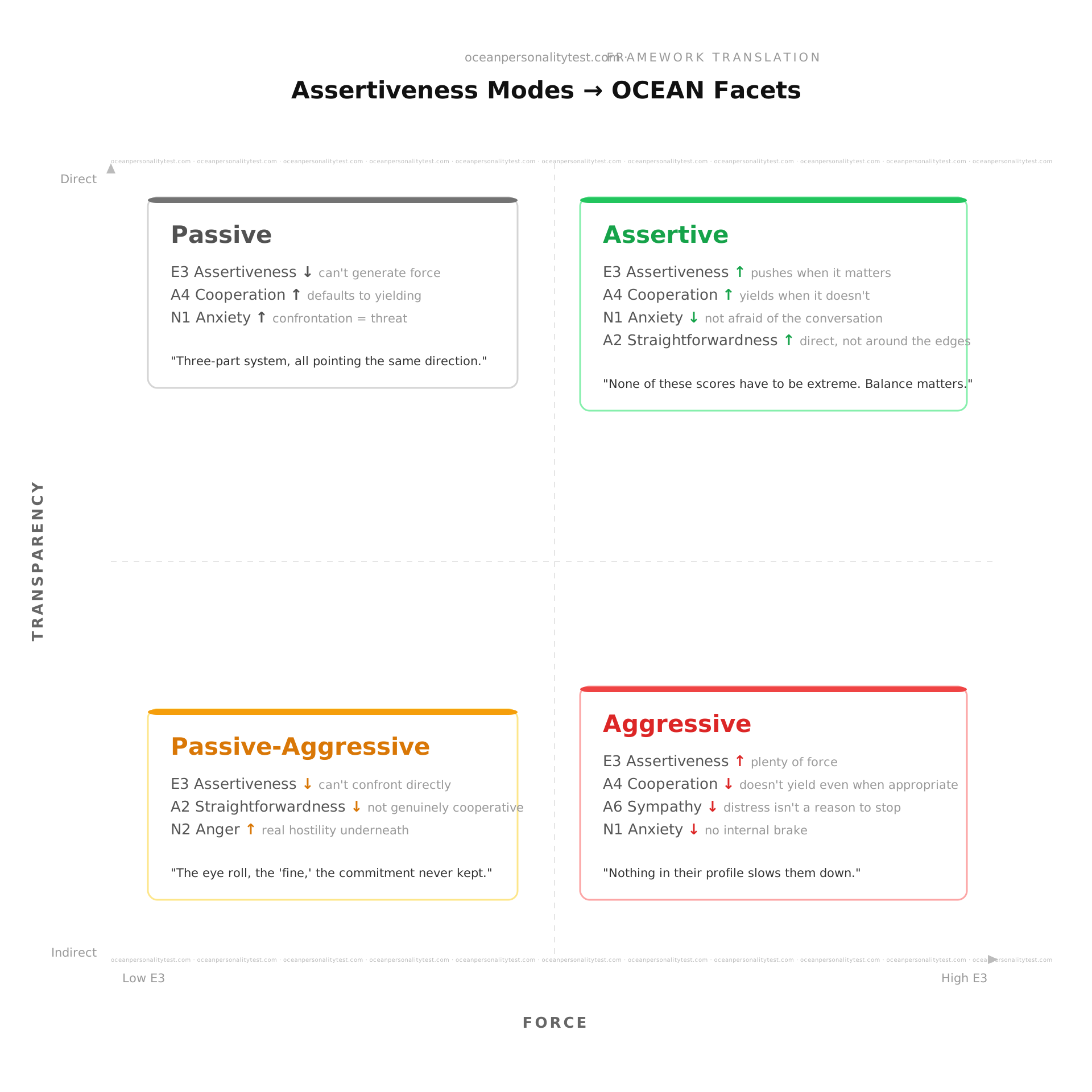
The passive mode comes from a specific combination: low Assertiveness (E3), high Cooperation (A4), and high Anxiety (N1). Low E3 means the person genuinely struggles to generate social force, the kind needed to hold a position under pressure. High A4 means they default to yielding when someone pushes back. High N1 means confrontation itself registers as threatening, so the nervous system is motivated to avoid it before the situation even escalates. The result isn't weakness so much as a three-part system that all points the same direction.
Aggressive communication has a different signature entirely: high E3, low A4, low Sympathy (A6), low N1. There's plenty of force. The problem is the absence of counterweights. Low A4 means they don't yield even when yielding would be appropriate. Low A6 means other people's distress doesn't register as a cost worth adjusting for. Low N1 means they're not anxious about the aftermath of a hard conversation, so there's no internal brake. The aggression isn't always intentional; sometimes it's just that nothing in their profile slows them down.
Passive-aggressive is the most structurally interesting of the four. The combination is low E3, low Straightforwardness (A2), and high Anger (N2). Low E3 means the person can't or won't confront directly, same as the passive mode. But the similarity stops there, because low A2 means they're also not genuinely cooperative, and high N2 means they're carrying real hostility. So you get someone who can't say what they're feeling (low E3), doesn't actually intend to comply (low A2), and is genuinely angry underneath (high N2). The indirectness isn't a strategy; it's what happens when those three things collide. The eye roll, the "fine," the commitment made with no intention of being kept, these are the only outputs available when the system is wired that way.
Assertive communication lands at moderate-to-high E3, moderate A4, low N1, and high A2. The person can push when something matters. They can also yield when it doesn't, because A4 isn't flat-zero. They don't fear the conversation (low N1), so they're not avoiding it, but they also communicate directly rather than around the edges (high A2). None of these scores have to be extreme. What matters is the balance across them.
The reason this framework is useful is that the components are independent. Someone can have high E3 and still be passive-aggressive if their A2 is low and their N2 is high. Someone can score low on the E3 facet and still manage to communicate assertively because their N1 is very low, removing the anxiety that usually prevents low-E3 people from holding their ground. The label tells you almost nothing. The facet breakdown tells you where the leverage is.
The 30-facet OCEAN personality test scores E3, A2, A4, A6, N1, and N2 as separate measurements. You see the full picture, not a single assertiveness number that collapses all of this into one dimension.
Take the 30-facet OCEAN personality test and find out which facets are shaping how you communicate.